How Can Technology Improve Trade Show Marketing and Lead Generation?
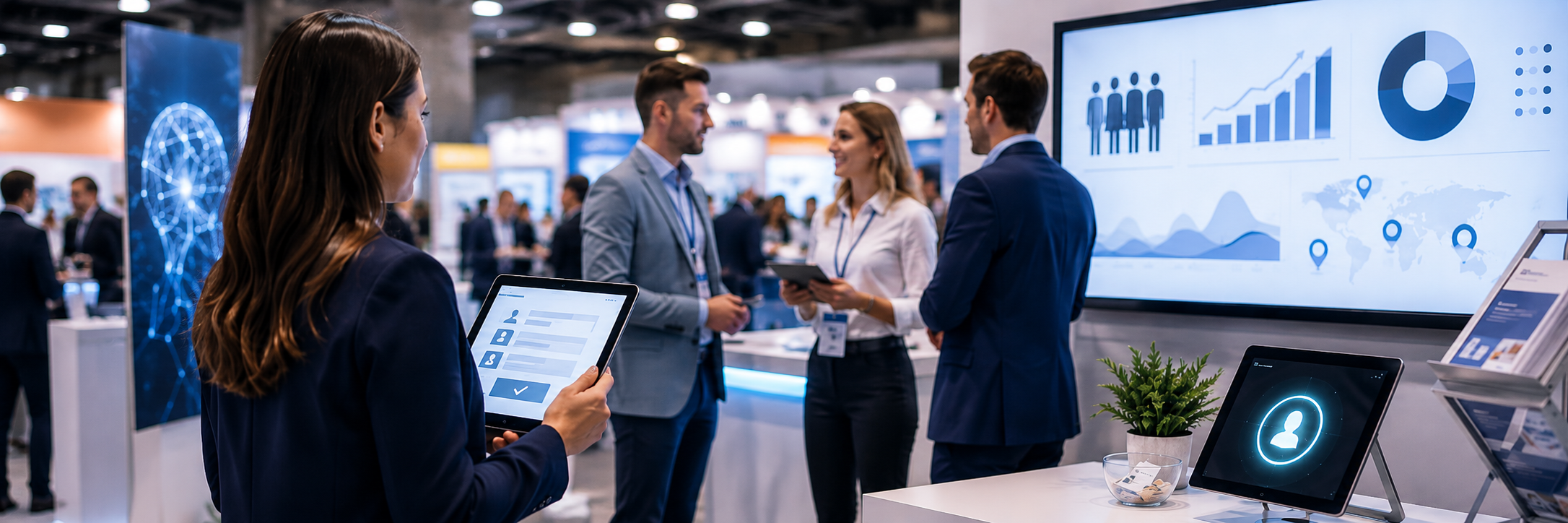
Trade shows can create valuable opportunities for businesses to meet prospects, demonstrate solutions, build relationships, and generate new sales conversations. But collecting a large number of contacts does not necessarily mean an event was successful. The more important question is what your team actually knows about those contacts after each interaction.
A badge scan may provide a name, company, and email address, but it rarely captures why someone stopped at the booth, what problem they described, how interested they were, or what they expected to do next. When that context disappears, sales teams are left with a list of contacts rather than a clear set of opportunities.
Technology is changing this process. Modern event platforms can connect identity, lead capture, conversation intelligence, qualification, CRM data, and analytics so exhibitors can make better decisions during and after an event. The goal is not simply to collect more leads. It is to understand which conversations matter and give sales teams enough context to act on them.
Why Traditional Trade Show Lead Generation Can Be Inefficient
Traditional lead collection often depends on badge scanners, business cards, paper forms, spreadsheets, and manual notes. These tools can work for basic contact collection, but they become less useful when a booth team is handling dozens or hundreds of conversations in a short period.
Consider two prospects who both scan their badges.
The first person asks one general question, accepts a brochure, and leaves. The second explains that their company is reviewing solutions this quarter, mentions a problem with its existing system, asks about integration, and requests a follow-up conversation.
A standard scan may treat both people almost identically.
The sales team, however, should not.
This difference is one of the most important opportunities in modern trade show marketing. Technology can help preserve the information that separates casual engagement from genuine buying interest.
What Technology Adds to Trade Show Marketing
Technology becomes valuable when it captures the full interaction rather than treating the badge scan as the end of the process.
A modern event workflow can begin with verified attendee information, capture the interaction, organize conversation details, identify relevant signals, qualify the lead, and move useful information into the appropriate sales workflow.
Instead of asking only, “How many leads did we collect?”, teams can begin asking better questions:
Who showed genuine interest? What did they need? What did they say? How closely do they match our target customer? What should happen next?
Those answers make event data considerably more useful.
Capture Contact Information Without Creating Friction
The first step is still accurate contact capture. Attendees should be able to share their information quickly, without being forced through a long form or repetitive registration process.
Digital credentials, QR codes, business cards, and badge information can provide different ways to establish identity. The important consideration is how that information is organized after capture.
A useful record should give the sales team a reliable starting point while leaving room for additional context from the conversation.
This is where a trade show lead retrieval system can become more useful than a simple scanner. Instead of creating a basic contact record and leaving the rest to the sales representative, a more connected system can associate the contact with notes, qualification information, engagement signals, and follow-up requirements.
Make the Trade Show Lead Form More Meaningful
A digital lead form does not need to ask an attendee twenty questions to produce useful information.
The strongest forms usually focus on information that directly supports qualification or follow-up. For example, a company might ask what area the visitor is interested in, what challenge they are currently facing, or whether they are researching a solution for an immediate project.
The exact fields should depend on the sales process.
A software company may want to know which platform a prospect currently uses. An equipment manufacturer may care more about project timing and application requirements. A professional services company might want to understand the type of problem the visitor needs help solving.
The principle is simple: collect information that someone will actually use.
Long forms create unnecessary friction, while overly simple forms provide little context. The right balance captures enough information to support a useful next step without turning a booth conversation into an administrative task.
Capture the Conversation, Not Just the Contact
The most valuable information at a trade show is often spoken rather than scanned.
A prospect may mention a business challenge, a competitor, an internal deadline, a previous experience, or a specific question. These details can completely change how the sales team should approach the follow-up.
Modern conversation intelligence can help preserve that context when used with appropriate consent and privacy controls. A conversation can be recorded, transcribed, summarized, or converted into structured notes so the representative does not have to remember everything later.
For example, imagine a prospect says that their company is comparing several solutions and needs to make a decision before the next quarter.
That single statement provides considerably more sales context than a job title alone. It suggests an active evaluation, a potential timeframe, and a reason for timely follow-up.
The technology does not replace the salesperson's judgment. It helps ensure that useful information survives the busy event environment.
Use AI to Identify Stronger Buying Signals
Artificial intelligence can make captured information easier to interpret at scale.
Rather than requiring a sales representative to manually review every interaction, AI can help identify signals such as an active evaluation, a specific business problem, a requested demonstration, a stated timeline, or a question about pricing or implementation.
This creates an important distinction between lead capture and lead understanding.
Capture tells you that someone interacted with your business.
Understanding helps explain whether that interaction deserves immediate attention.
AI can also summarize conversations into concise records, making it easier for a representative to review what happened before contacting a prospect. This is particularly useful when several members of a booth team are collecting leads throughout a busy event.
Prioritize Leads Based on Fit and Engagement
Not every lead should receive the same follow-up.
A useful qualification approach considers both who the person is and what happened during the interaction. Firmographic information can indicate whether the company fits the target market, while conversation information can provide clues about current intent.
A high-fit prospect who discussed an immediate project and requested a meeting should probably be handled differently from a high-fit attendee who simply picked up information.
The same applies to unexpected interactions. Someone may appear to be outside the ideal customer profile but have a strong reason for engaging with the business. Automatically discarding such contacts could mean overlooking useful opportunities.
Technology can therefore help create practical lead categories based on fit and engagement rather than relying on contact volume alone.
Connect Trade Show Lead Tracking With the CRM
Good trade show lead tracking should continue after the event ends.
One common problem is that event data remains isolated in an export file. The marketing team may have one spreadsheet, the sales team another list, and the CRM may eventually receive only basic contact information.
A connected workflow reduces this fragmentation.
Relevant information can be mapped into CRM fields so sales teams can see the event source, qualification details, conversation notes, lead status, ownership, and next action in one place.
This also makes reporting easier. Teams can look beyond the number of contacts collected and evaluate how event-generated leads move through the sales process.
For example, a business could compare the number of contacts collected at an event with the number that became qualified leads, sales meetings, opportunities, and eventually revenue.
That gives the event a more meaningful business context.
Personalize Follow-Up From What Was Actually Discussed
One of the weakest forms of post-event communication is the generic message sent to everyone.
“Great meeting you at the show” may be polite, but it does not demonstrate that the salesperson remembers the conversation.
Technology can help sales teams create more relevant follow-up by preserving the actual discussion.
If an attendee asked about a specific integration, the follow-up can address that topic. If they requested pricing information, the representative can provide it. If they mentioned a particular business challenge, the message can explain how the relevant solution addresses that problem.
AI can assist with drafting these messages, but human review remains important. The objective is not to automate relationships. It is to remove repetitive administrative work while helping salespeople communicate with greater context.
Recent counterTEN content similarly emphasizes the difference between a basic contact record and a conversation record, particularly when the goal is meaningful post-event follow-up.
Improve the Attendee Experience Alongside Lead Generation
Technology should not make an event feel like a data-collection exercise.
Attendees want to enter the venue easily, find useful sessions, connect with relevant people, and receive information that is actually helpful. Sponsors want qualified conversations. Organizers need visibility into engagement and event performance.
These objectives can support each other when the technology is designed around the complete event journey.
Digital ticketing and wallet-based credentials can simplify registration and access. Digital business cards can make networking easier. Personalized event experiences can help attendees discover relevant content, sponsors, or connections.
For sponsors, the same environment can provide better information about interactions and lead quality.
The result is a more connected event experience rather than several disconnected systems operating independently. The conference platform currently describes this broader approach across ticketing, digital identity, sponsor intelligence, AI conversation capture, lead qualification, CRM-ready data, and analytics.
Measure Lead Quality Instead of Only Lead Volume
A successful event should not be judged solely by how many people were scanned.
Lead volume is useful, but it is only the beginning.
Teams should also examine qualification rates, meaningful conversations, meetings generated, opportunities created, follow-up speed, pipeline contribution, and eventual revenue where the sales cycle allows it.
This changes the conversation after the event.
Instead of saying, “We collected 600 leads,” a marketing team can provide a more useful picture: how many contacts matched the ideal customer profile, how many showed meaningful buying signals, how many were accepted by sales, and how many progressed into opportunities.
For sponsors, this can make event investment easier to evaluate. For organizers, it can provide stronger evidence of sponsor value and help identify which experiences generate meaningful engagement.
Technology Can Help Sponsors Demonstrate ROI
Event sponsorship often represents a significant investment. Sponsors therefore need more than attendance numbers or raw scan totals to understand whether an event delivered value.
Imagine two conferences.
The first produces 800 contacts, but most are poorly qualified and receive generic follow-up.
The second produces 300 contacts, but a large proportion match the company's target market, had meaningful conversations, requested information, and entered sales workflows.
The second event may ultimately be more valuable despite generating fewer contacts.
Technology helps make this distinction visible.
When event interactions can be connected to lead qualification, CRM activity, pipeline, and revenue data, businesses can evaluate events based on business outcomes rather than impressive-looking contact counts.
What Should Businesses Look for in Event Technology?
Choosing an event technology platform requires more than comparing feature lists. The system should fit the way the sales and event teams actually work.
Start with ease of use. If booth representatives need extensive training or several devices to capture one interaction, adoption can suffer.
Next, evaluate data quality and integration. Ask how information is captured, structured, enriched, and transferred into the CRM.
Conversation capabilities are also worth examining, particularly if your sales process depends heavily on understanding customer needs. If conversations are recorded or processed, make sure the platform provides appropriate consent and privacy controls.
Finally, consider reporting. The technology should help answer business questions, not simply display scan totals.
A Practical Workflow for the Next Trade Show
The most effective technology strategy does not require automating everything immediately.
Before the event, define your ideal customer profile, qualification criteria, follow-up process, and success metrics. This gives the team a clear framework for evaluating interactions.
During the event, focus on capturing accurate identity information and preserving useful conversation context. Representatives should know what information matters and how qualified leads will be handled.
Immediately after each meaningful conversation, information should be organized while the details are still fresh. Where appropriate, AI can assist with transcription, summarization, classification, and qualification.
After the event, qualified records should move into the CRM with ownership and next steps clearly defined. Follow-up should reflect the actual interaction rather than treating every attendee identically.
Finally, review the results against the original objectives. Look at lead quality, engagement, sales activity, pipeline, and revenue rather than relying on contact volume alone.
This creates a repeatable process that can improve from one event to the next.
The Real Value Is Turning Event Conversations Into Actionable Data
Technology does not make a trade show successful simply because it uses AI, digital credentials, or automated workflows.
Its value comes from solving practical problems.
When a booth team can capture accurate identity information, preserve conversation context, identify buying signals, prioritize leads, and move useful data into the sales workflow, the event becomes easier to act on.
That is the difference between collecting contacts and creating actionable event intelligence.
For exhibitors, the benefit lies in a more straightforward path from conversation to follow-up. For sponsors, it offers enhanced visibility into the quality and potential value of their event investments. For organizers, connected data can illustrate sponsor performance while also enhancing the attendee experience.
The most useful event technology is therefore not necessarily the technology with the longest feature list. It is the technology that removes friction, preserves valuable context, and helps people make better decisions before, during, and after the event.
Frequently Asked Questions
How does technology improve trade show lead generation?
Technology can improve lead generation by capturing accurate attendee information, preserving conversation context, identifying buying signals, qualifying contacts, and connecting event data with CRM and follow-up workflows.
What is a trade show lead retrieval system?
A trade show lead retrieval system captures attendee information during an event through methods such as badge scanning, QR codes, digital credentials, or business cards. More advanced systems can also organize qualification and engagement data.
What should a trade show lead form include?
A lead form should collect essential contact information and a limited number of useful qualification details, such as the attendee's area of interest, business need, or expected purchasing timeframe.
How can companies improve trade show lead tracking?
Companies can improve tracking by defining qualification criteria, recording conversation context, assigning lead ownership, connecting event data with the CRM, monitoring follow-up, and measuring how leads progress through the sales pipeline.
How should businesses measure trade show success?
Businesses should look beyond the number of contacts collected. Qualified leads, meaningful conversations, meetings, opportunities, pipeline contribution, revenue, follow-up speed, and lead-to-customer conversion can provide a more complete view of event performance.