How Can AI Improve Conference Networking, Lead Capture, and Follow-Ups?
A busy conference can generate hundreds of introductions, booth visits, session questions, and informal conversations. Yet much of that value disappears after the venue closes. Attendees forget names, sponsors receive lead lists with little context, and sales teams struggle to remember what each person actually requested.
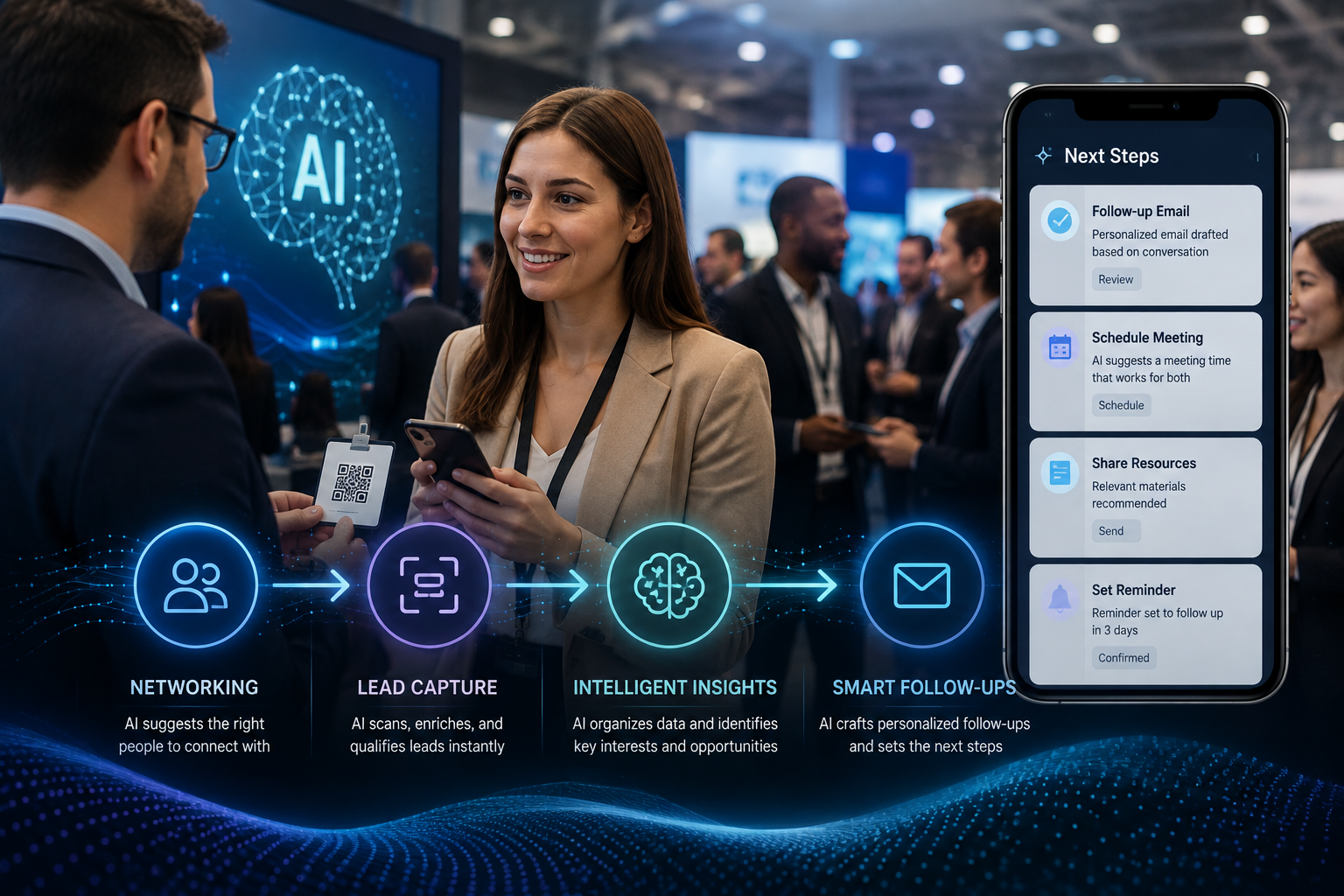
AI can close these gaps when it supports a well-designed event process. Before the event, it can recommend relevant people, sessions, and exhibitors. During the event, it can organize approved interaction data and turn conversations into structured notes. Afterward, it can help teams prioritize leads and prepare relevant follow-ups. The real value of conference AI next steps is not automating every human interaction. It is helping people act on the context they would otherwise lose.
That distinction matters. Networking still depends on curiosity, trust, and a worthwhile conversation. AI works best as an assistant that reduces administrative work and brings useful information to the surface.
Where AI Adds Value Across the Conference Journey
Registration, networking, sponsor engagement, and follow-up often sit in separate systems. A connected approach can create a more useful journey:
| Event stage | What AI can support | Practical outcome |
| Before the conference | Profile-based recommendations, meeting suggestions, and session discovery | Attendees find more relevant people and content |
| During the conference | Lead enrichment, conversation transcription, summaries, and qualification prompts | Sponsors retain the context behind each interaction |
| After the conference | Lead prioritization, routing, message drafting, and engagement analysis | Teams follow up with the right action and information |
The platform still needs reliable identity and permissions. Otherwise, AI may connect activity to the wrong person or use information the attendee did not expect to share.
How AI Makes Conference Networking More Relevant
Traditional networking is often left to chance. An attendee may walk into a reception full of suitable contacts but speak only with people they already know. An exhibitor may spend most of the day with casual visitors while a strong potential buyer passes nearby without realizing the solution is relevant.
AI-powered matchmaking can reduce this randomness. It may evaluate information that attendees choose to provide, such as role, industry, interests, challenges, session choices, or stated event goals. It can then recommend people, exhibitors, roundtables, or demonstrations that appear relevant.
Recommendations Need a Clear Reason
A useful recommendation should explain the connection. For example, “Both of you are evaluating identity verification for large events” is more helpful than “You may want to meet.” Clear reasoning lets attendees decide whether the introduction deserves their time. It also helps organizers assess whether the matching criteria align with the event’s purpose.
Organizers should not treat every behavior as buying intent. A session visit or saved sponsor profile may show curiosity. Good matchmaking considers several signals and leaves the decision to the attendee.
AI Should Create Openings, Not Replace Conversation
Once a match is made, a brief prompt can provide a shared starting point, but participants should control the conversation. Verified identity and wallet-based ticketing can connect an attendee’s chosen profile, credential, and approved interactions without repeated form-filling. The aim is intentional engagement, not greater data exposure.
How AI Strengthens Conference Lead Capture
A badge scan answers one basic question: who stopped at the booth? It rarely explains why the person stopped, what problem was discussed, which product mattered, or what should happen next. Effective conference lead capture combines contact details with qualification and conversation context.
For example, an operations leader may visit a demonstration while comparing access systems for three regional events. The person asks for an integration guide and agrees to a technical call. A scan identifies the visitor; a structured record preserves the need, scope, requested resource, and agreed action.
A Conference AI Transcript Preserves Useful Context
When recording is appropriate and the participant has knowingly agreed, a conference AI transcript can convert a booth conversation into searchable text. AI can summarize topics and suggest actions when representatives have little time for detailed notes.
However, names, acronyms, numbers, and commitments may be wrong. A representative should review the summary before it enters the CRM, and the attendee’s direct request should take priority over an AI inference.
Qualification Should Match the Real Sales Process
Lead scoring is useful only when its rules reflect the sponsor’s goals. Teams may consider fit, need, decision influence, timing, engagement depth, and the agreed action.
A high score should have an understandable basis. Human review remains important because a long conversation might represent buying interest, customer support, media, or research.
What Conference AI Next Steps Should Look Like
The most useful output from event AI is not a transcript or score. It is a specific, appropriate action that someone can complete.
For each meaningful interaction, the system should help answer five questions:
- Who owns the follow-up?
- What did the attendee ask for?
- Which context should the response mention?
- When should the action happen?
- What outcome will show that the follow-up was completed?
These conference AI next steps may include sending a technical guide, proposing meeting times, introducing a specialist, enrolling a low-intent contact in an educational sequence, or setting a future task. They should not default to the same sales email for every person.
Improve the Conference Lead Response
A strong conference lead response begins with the conversation. “You asked how our credentialing workflow connects with your registration process” is more useful than a generic thank-you.
AI can draft the message from an approved summary, but the assigned representative should confirm the recipient, facts, promised material, and timing. High-fit prospects may need personal attention; educational requests can receive the right resource; casual visitors may suit a permission-based nurture path. Media, partners, customers, and job seekers need different routing.
How Organizers and Sponsors Can Measure the Impact
Scan totals show activity, not whether AI improved the event. Organizers can review match acceptance, completed meetings, attendee feedback, sponsor participation, and activation engagement. Sponsors can track qualified conversations, completed responses, booked meetings, opportunities, and pipeline influence.
Compare results with a defined baseline: note completeness, routing accuracy, follow-up relevance, and meeting conversion. Attribution needs care because a deal may involve prior marketing, an existing relationship, the conference, and later conversations. Event analytics can show influence without claiming that one interaction caused the sale.
Privacy, Accuracy, and Human Oversight
Conversation intelligence may handle personal or confidential information. Organizers should explain what is collected, why it is needed, who receives it, how long it is retained, and what choices attendees have. Recording and privacy laws vary, so legal review may be appropriate before enabling audio capture across locations.
counterTEN’s privacy policy explains how information is handled in connection with its services. Each organizer and sponsor should also document its own purpose, permissions, access controls, retention rules, and downstream marketing practices.
AI transcripts, summaries, scores, and recommendations can contain errors. The NIST AI Risk Management Framework encourages organizations to govern, map, measure, and manage AI risks. Event teams should test before launch, allow corrections, monitor output quality, and keep humans responsible for consequential decisions.
For events involving UK attendees or operations, the UK Information Commissioner’s AI and data protection guidance is a useful reference for transparency, fairness, accuracy, data minimization, and individual rights. Other regions may impose different requirements.
Common Mistakes That Reduce AI’s Value
Adding AI before defining qualification, ownership, response standards, and success measures will move unclear data faster. Collecting unnecessary fields adds friction and governance work. Letting summaries or scores trigger outreach without review can spread mistakes.
Other warning signs include unexplained recommendations, duplicate leads, weak venue connectivity, poor CRM mapping, unclear consent, and dashboards that report activity but not outcomes.
What Costs and Capabilities Should Teams Compare?
Pricing may depend on attendees, exhibitors, users or devices, transcription volume, integrations, support, analytics, and event complexity. Compare the full workflow, not only the headline fee.
Ask about credential support, consent, offline operation, transcript review, scoring, routing, CRM mapping, duplicate handling, access controls, export, retention, and live-event support. A realistic attendee-to-follow-up demonstration can reveal hidden manual work or additional charges.
When Professional Assistance May Be Appropriate
A small event may need only basic scanning and manual follow-up. Professional support becomes more useful with multiple sponsors, complex credentials, recorded conversations, several CRM destinations, international attendees, custom scoring, or detailed reporting.
The project may require event technology, sales operations, integration, security, or privacy expertise.
counterTEN brings verified digital identity, wallet-based ticketing, AI-powered engagement and matchmaking, sponsor activation, lead capture, rewards, digital assets, and measurable analytics into a connected conference experience. Teams considering this approach can review the counterTEN conference platform to assess how those capabilities fit their event journey.
Frequently Asked Questions
1. What information does AI need to make useful conference networking recommendations?
Useful matching can begin with information attendees knowingly provide, such as their role, industry, interests, event goals, preferred topics, or meeting availability. Session choices and other approved engagement signals may improve relevance.
The system should not collect every available signal by default. Organizers should define a clear purpose, explain how recommendations work at an appropriate level, and let attendees control participation. Good recommendations also state why two people, sessions, or exhibitors may be relevant.
2. Can AI qualify a conference lead without a representative’s notes?
AI can use profile and engagement signals, but those signals rarely explain the full conversation. A session visit, booth scan, or content download may indicate interest without confirming need, authority, timing, or an agreed action.
Representative notes or an approved conversation summary add valuable context. A practical process combines AI organization with human confirmation, particularly before a lead is marked high priority or routed into direct sales outreach.
3. How should teams review a conference AI transcript before using it?
Check names, companies, technical terms, numbers, timelines, product references, and promised actions. Remove irrelevant or sensitive information that the team does not need.
Compare the summary with any representative notes, confirm the attendee’s requested follow-up, and correct the record before syncing it to the CRM. Teams should also establish retention and access rules for audio, raw transcripts, and summaries.
4. Should AI automatically send every post-conference email?
Usually, no. AI can draft messages, recommend content, and create tasks, but automation should match the risk and importance of the interaction.
Educational follow-ups may suit an approved sequence. High-value opportunities, technical discussions, pricing requests, and strategic accounts generally deserve human review. Every message should reflect the recipient’s permission, the actual conversation, and the promised next action.
5. How can sponsors tell whether AI improved conference ROI?
Compare the AI-assisted process with a prior event or defined baseline. Review record completeness, qualification consistency, routing accuracy, response completion, meeting conversion, opportunity creation, and pipeline influence.
Also examine attendee experience. Recommendation acceptance and feedback can reveal whether matching felt useful. Avoid measuring success only by scans, transcripts, or generated messages; these are outputs, not business outcomes.