The best
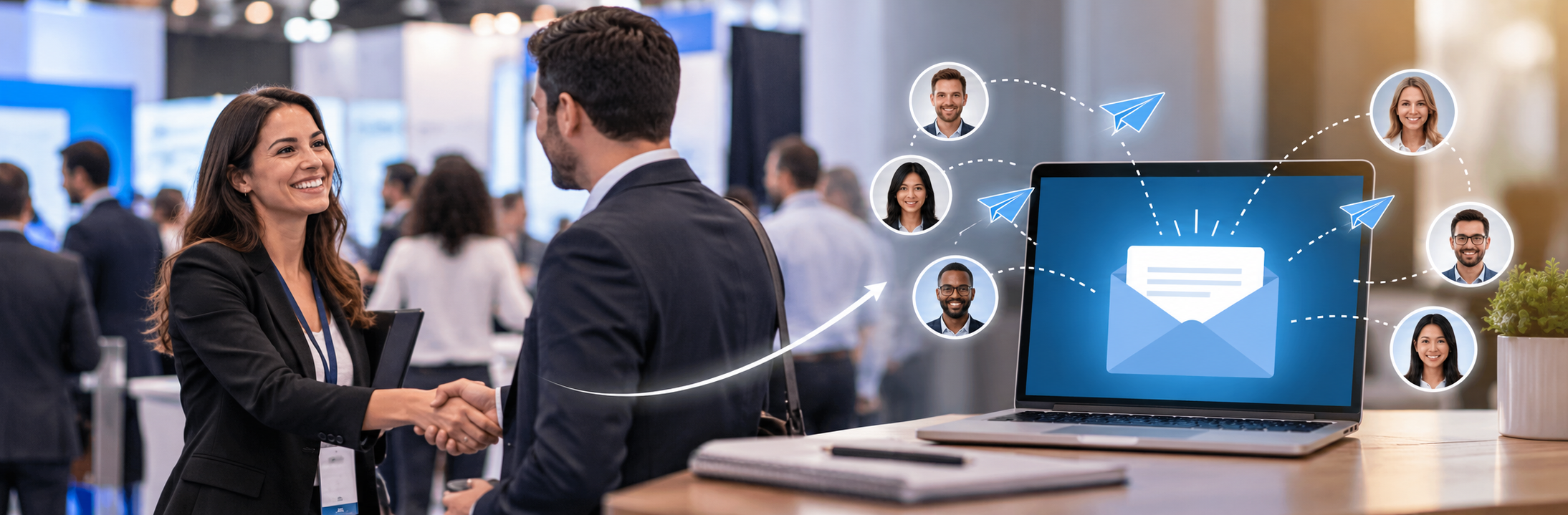
post event follow up email strategies share one idea: the follow-up is planned before the event, written from what was captured during it, and sent as a short sequence that matches how each person engaged. A pre-booked meeting, a booth demo, a session attendee and a quick badge scan each need a different message, a different sender and a different timeline.
That matters because the conversation is rarely the hard part of event marketing. The hard part is the week after, when hundreds of contacts sit in a spreadsheet, every exhibitor is emailing the same attendees, and the details that would make a message personal have already faded.
This guide covers the strategies that hold up at both conferences and trade shows: timing, segmenting by interaction, sequence design, personalization at scale, consent and deliverability, and how to measure what worked.
When Should You Send a Post Event Follow Up Email?
Send the first post event follow up email to high-intent contacts within one to two business days of meeting them, and to everyone else within the first week after the event. Anyone you promised something to on the floor should receive it by the day you named. Speed helps, but a specific email on day two still beats a generic one sent the evening the show closes.
Those windows are a starting point. Three adjustments make them work in practice.
Follow up on a rolling basis during multi-day events
At a three-day trade show, a hot lead from the first morning has already waited three days if you hold all follow-up until the show ends. Have reps send short notes to their best conversations each evening, even if the full follow-up comes later. Something as simple as "Good to meet you today. I'll send the integration details we discussed on Monday" sets an expectation and keeps you ahead of other exhibitors.
Respect travel and time zones
The last evening of a conference is when many attendees are packing, flying or catching up on work they missed. International events add another problem, because a message scheduled for your morning may land in the middle of someone else's night. Schedule sends for each recipient's local business hours where your email tool allows it.
Turn timing into a shared service level
A send date is easy to miss. A service level agreed between marketing and sales is harder to ignore. For example: hot leads contacted within one business day, warm leads within three, and everyone else within five, each with a named owner assigned before the show ends. Then track
time to first follow-up for every event so you can see where the process slows down.
Segment by How You Met, Not Only by Lead Score
Most advice splits event leads into hot, warm and cold. That is useful, but it leaves out the detail that shapes the email itself: the kind of interaction you had. Someone who sat through your 40-minute workshop expects a different message from someone who scanned their badge for a giveaway, even if both score as "warm."
This is also where conference attendee follow up differs from trade show follow-up. Conferences create more content-led touchpoints, such as sessions, roundtables and hosted dinners, so the natural hook is something you shared. Trade shows create higher volumes of short, product-led booth conversations, so the hook is usually a specific question or need.
| How you met |
Who should send it |
What the first email should focus on |
Suggested timing |
| Pre-booked meeting |
The person who ran the meeting |
Recap of what was agreed, materials promised, the next step already discussed |
Same day or next business day |
| Booth demo or detailed booth conversation |
The staffer they spoke with, or the assigned rep |
The question or problem they raised, one relevant resource, one clear ask |
1 to 2 business days |
| Session, workshop or talk attendee |
The speaker or content owner |
Slides, recording or resource promised, plus one idea that extends the session |
1 to 3 business days, once materials are ready |
| Hosted dinner, reception or side event |
The host or most senior attendee |
A personal thank-you that references the conversation, with a light next step |
1 to 2 business days |
| Quick badge scan or giveaway entry |
Marketing, sent from a named person |
A short, useful note and an easy way to choose whether to hear more |
Within the first week |
| Booked meeting that did not happen |
The rep who booked it |
Two or three easy times to reconnect, with no guilt in the tone |
1 to 2 business days |
Capture the follow-up while you capture the lead
None of these segments works unless the information exists. A badge scan usually gives you a name, company, title and email address. To write the follow-up, you also need a few fields recorded at the moment of the conversation:
- Interaction type: meeting, booth demo, session, hosted event or quick scan.
- Intent: a simple rating every staffer applies the same way.
- Promised next step and due date: "pricing for 3 sites by Monday" is a follow-up written in advance.
- Topic or product interest: so the email points to one relevant resource.
- Communication preference: whether they asked for a call, said they only want the one resource, or asked not to receive marketing email.
- Owner: the person responsible for the first touch.
If your team uses
AI lead scoring, these fields also give the model better inputs than scan data alone.
Build a Short Sequence Instead of a Single Email
Plan three or four touches over roughly two to three weeks, and make each one add something new: a recap, a piece of proof, a different channel and a clear close. A single email is easy to miss in a post-show inbox, while a string of "just checking in" messages wears away the goodwill the conversation created.
| Touch |
Example timing |
Purpose |
What it contains |
| 1. Recap |
Day 1 to 2 |
Continue the conversation |
The detail they shared, what you promised, one specific ask |
| 2. Proof |
Day 4 to 6 |
Give them a reason to reply |
A short customer example, the session recording, or the answer to a question left open at the event |
| 3. Channel switch |
Day 8 to 10 |
Reach them outside a crowded inbox |
A call for hot leads who shared a number, or a LinkedIn message that references the event |
| 4. Close the loop |
Day 14 to 21 |
Get a clear answer |
Ask whether to continue, offer a lighter option, and let them choose ongoing updates |
Treat these intervals as examples. Shorten them for hot leads with an active project and lengthen them for early-stage contacts. One caution on touch three: Canada's regulator treats commercial direct messages on platforms such as LinkedIn as electronic messages under its anti-spam law, so the same consent rules apply there as to email.
For the elements every individual message needs, plus templates for hot, warm and cold leads, see our guide on
what to include in a trade show follow-up email. The two examples below cover situations that guide does not.
Conference Attendee Follow Up Example: After a Session
Subject: Slides from "[Session title]" and the checklist you asked about
Hi Amara,
Thanks for staying after our session at [Conference Name] to ask about measuring sponsor engagement across regional events. The slides are here: [link].
Your question deserved more than two minutes, so I've added a one-page checklist that covers how teams usually set this up.
If it would help to talk it through with your events team, I'm free Wednesday at 10 or Thursday at 3, your time.
[Name] | [Title] | [Company]
It works because it delivers what the session promised before asking for anything, and the ask offers two concrete times.
Trade Show Follow Up Email Example: Closing the Loop
Subject: Keep our [Event Name] conversation open?
Hi Jordan,
I've sent a couple of notes since we spoke at booth 412 about [the problem they raised]. I don't want to fill your inbox if the timing isn't right, so which of these would be most useful?
- A 20-minute call in the next two weeks
- A check-in next quarter instead
- No further emails from me
Just reply with 1, 2 or 3.
[Name] | [Title] | [Company]
A final email that makes saying no easy gives a busy prospect a low-effort way to answer, and every answer tells you where the lead belongs.
Know when to stop
Write stop rules into the sequence before it starts. Pause it automatically when someone replies, books a meeting or unsubscribes. Route existing customers to their account manager rather than a prospecting sequence, and check whether a contact is already in an open deal owned by another rep. Finally, make sure marketing automation and rep outreach are coordinated, so nobody receives a nurture email and a personal note on the same morning.
Personalize at Scale Without Sounding Automated
Personalize the first two lines by hand and standardize the rest by segment. Writing hundreds of post-event emails from scratch isn't realistic, and it isn't necessary. The reader judges the opening: if it proves you remember them, the rest can follow a template written for their segment.
A few habits make the difference:
- Write the opening from the captured note. "You mentioned your reps lose track of serious buyers after the show" does more than any compliment about the event.
- Be honest when there is no note. If all you have is a scan, reference what you do know, such as the event, their role or the product area where you met, instead of pretending you had a long chat.
- Clean badge data before merging. Registration data often arrives in capitals, with abbreviated titles or company names typed several ways. A greeting like "Hi JOHN" or a blank first name signals a mass send immediately.
- Send from a real person. Use the name of someone they met, and route replies to that person's inbox rather than a no-reply address.
- Keep it short and light on links. A plain, text-style email with one link and one call to action reads like correspondence rather than a campaign.
Using AI to draft follow-ups
AI writing tools can turn booth notes into first drafts quickly, which helps when a team returns with hundreds of contacts. Treat each draft as a starting point. Check every name, company and detail against the notes, remove anything the conversation didn't include, and never let a draft promise a price, timeline or feature your team hasn't agreed to. If the note says "interested in analytics," the email shouldn't invent a problem the person never mentioned.
Consent, Compliance and Deliverability
A badge scan gives you a contact record, not blanket permission to send marketing email. What you may send depends on where the recipient is, what they agreed to at registration and at your booth, and whether the message is a one-to-one follow-up or a marketing campaign. Every commercial email also needs an honest sender, a postal address and a working opt-out.
The points below are a practical summary, not legal advice. Check your own situation with counsel, especially before adding event contacts to ongoing marketing.
United States: CAN-SPAM
The FTC's
CAN-SPAM compliance guide states that the law makes no exception for business-to-business email. Commercial messages need accurate header information, a subject line that reflects the content, a valid physical postal address and a clear way to opt out, and opt-outs must be honored within 10 business days. The FTC lists penalties of up to $53,088 for each email that violates the law, and both the company being promoted and the company sending can be held responsible.
Protect deliverability after the show
A post-event send can be one of the largest bursts of email an event team sends, which is when deliverability problems tend to surface. Google
requires senders of more than 5,000 messages a day to Gmail addresses to authenticate their email, offer one-click unsubscribe that is processed within two days, and stay under a spam-rate threshold. Google's sender guidelines set that ceiling at 0.3% as reported in Postmaster Tools. Many event contacts use work addresses on other providers, but the same habits protect your sender reputation everywhere:
- Authenticate your sending domain with SPF, DKIM and DMARC.
- Send hot-lead follow-ups one-to-one from rep mailboxes rather than in one blast.
- Validate addresses captured from badges or business cards before the first send, because typos and outdated records cause bounces.
- Remove duplicates collected across scanners, staff phones and spreadsheets.
- Sync unsubscribes across every tool that sends on your behalf.
How to Measure Follow-Up and Choose Event Marketing Platforms
Measure your follow-up by segment rather than as one campaign: how quickly each group was contacted, how many replied, how many booked a meeting and how much pipeline followed. Open rates are a weak signal on their own, because privacy features in some email apps load content automatically and can inflate opens.
The measures worth tracking for every event:
- Time to first follow-up, by segment, against the service level you set.
- Reply rate by segment and by touch number, which shows whether the recap, the proof or the close earns responses.
- Meetings booked per 100 contacts in each segment.
- Bounce and unsubscribe rates, which flag data quality and relevance problems.
- Pipeline and revenue at 90 and 180 days, tagged to the event source.
Compare these across events. If session attendees reply far more often than booth scans, that is useful evidence for where your next sponsorship budget should go. For the wider picture, see how sponsors
measure and improve trade show ROI.
What to look for in event marketing platforms
Most of the strategies above depend on data that a basic badge scanner never collects. When comparing event marketing platforms and lead capture tools, check whether they can:
- Record notes, qualification answers and interaction type during the conversation.
- Store communication preferences and consent details with each lead.
- Sync to your CRM with the event source attached, so follow-up can start the same day.
- Assign owners and route hot leads while the event is still running.
- Report by segment and compare one event with another.
- Give attendees something in return, such as digital business card exchange or relevant matchmaking, so they share details willingly.
counterTEN's event lead capture and analytics for conferences, for example, brings attendee identity, conversation capture, lead qualification, CRM-ready data and event analytics together, so the context recorded at the booth is still attached when the follow-up is written.
What Breaks a Post-Event Follow-Up Program
Most follow-up failures are process failures rather than writing failures. Watch for these:
- No named owner. Leads assigned to "sales" in general tend to be contacted by no one in particular.
- Two teams, one inbox. A marketing nurture email and a rep's personal note land on the same morning and send mixed signals.
- One message for the whole scan list. Existing customers, partners, competitors and job seekers all receive a prospecting email.
- Forgetting the no-shows. People who booked a meeting and missed it showed intent before the event. A quick reschedule offer keeps it from going to waste.
- Treating a shared attendee list as an opt-in list. Receiving the data is not the same as having permission to market to it.
- Judging success on opens. Replies, meetings and pipeline are the numbers that show whether the follow-up worked.
Conclusion: Make Follow-Up a System, Not a Scramble
The strongest post event follow up email strategy is less about a perfect template and more about a system. Decide the follow-up before the event, capture the details that make it personal, segment by how you met, and run a short sequence with clear stop rules. Add consent records and clean data, and your emails reach inboxes as well as people.
If you change one thing before your next show, start with capture. Ask booth staff and speakers to record the interaction type, the promised next step and a few words of context for every meaningful conversation. Every later step becomes easier once that information exists.
Planning your next conference or trade show? Explore how counterTEN supports lead capture, qualification and follow-up for conferences, and talk to the team about fitting it into your event workflow.
Frequently Asked Questions
What is a post event follow up email?
A post event follow up email is a message sent after a conference, trade show or other event to someone you met there. It refers to the interaction you had and asks for one specific next step, such as a meeting, demo or trial. That is what separates it from a newsletter or a general "thanks for visiting" announcement.
How is conference attendee follow up different from trade show follow-up?
Conference follow-up usually builds on shared content, such as a session, workshop or roundtable, so the first email often delivers slides, a recording or a resource. Trade show follow-up usually builds on a short product conversation at a booth, so it focuses on the question or need the visitor raised. Many events include both, so segment by interaction.
Should sales or marketing send the post-event follow-up?
Whoever had the conversation should send the first message to high-intent contacts, because the recipient will recognize the name. Marketing usually owns sequences for lighter interactions, such as quick scans and giveaway entries, sent from a named person. Agree on the split before the event and use stop rules so nobody receives two competing emails.
How long should a post-event follow-up sequence run?
For most B2B events, three or four touches over two to three weeks is a sensible default. Hot leads with an active project may move faster, and early-stage contacts can move into a slower nurture program after the final touch. Stop the sequence as soon as someone replies, books a meeting or opts out.
Can I email everyone on an attendee list the organizer shared?
Not automatically. It depends on what attendees agreed to at registration, the laws where they are located, and your agreement with the organizer. Check those terms first. Where consent is unclear, get advice before sending, because in some jurisdictions, including Canada, an email that asks for consent is itself treated as a commercial message.
What should I send to someone who booked a meeting but didn't show up?
Send a short, friendly note within a day or two that assumes good intent, mentions what you planned to cover, and offers two or three specific times to reconnect. Avoid guilt or pressure. If they don't respond, move them into the same sequence as your other warm leads rather than chasing them repeatedly.
Should I use AI to write post-event follow-up emails?
AI can save time by turning booth notes into first drafts, but each draft needs human review. Check names and details against your notes, remove anything the conversation didn't include, and make sure the email doesn't promise prices, timelines or features your team hasn't agreed to. The personal opening should come from what actually happened.