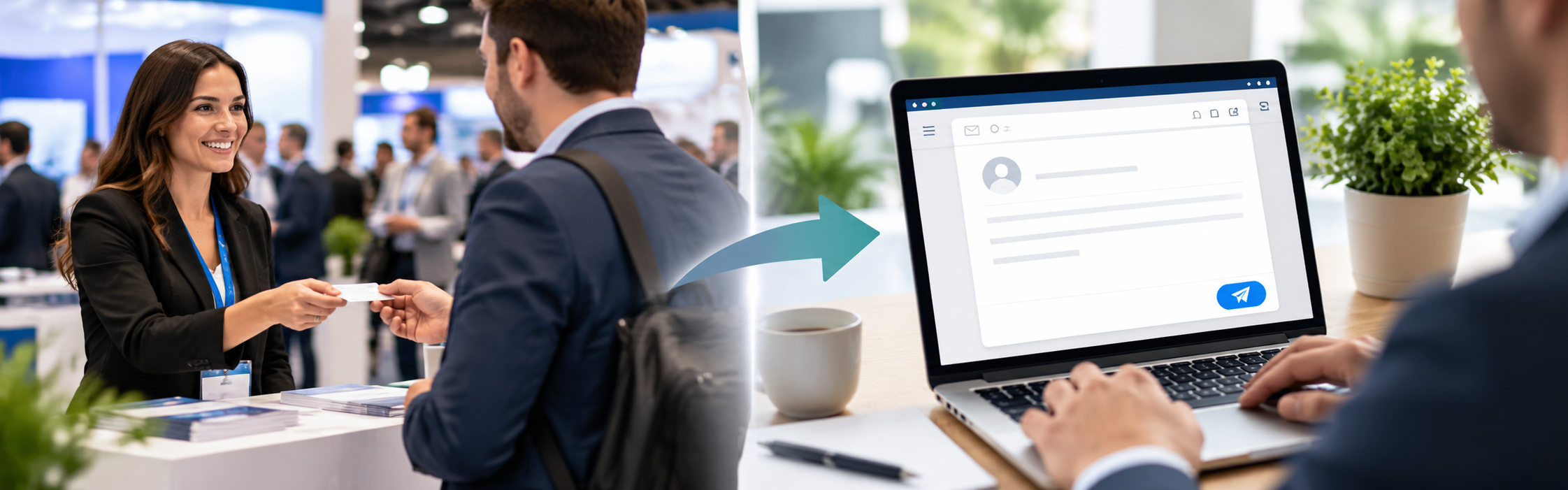
You had a good conversation at the booth. The prospect nodded, asked about pricing, and scanned their badge. Two weeks later, your email sits unopened between forty other "Great meeting you!" messages from every exhibitor they walked past.
A good
trade show follow-up email should include five things: a reference to the conversation you actually had, a reminder of who you are, something useful tied to the problem they mentioned, one clear next step, and easy contact details. Send it soon after the event, while they still remember you.
This guide covers each element, how to change your message for hot, warm, and cold leads, when to send it, example templates, and the mistakes that cause follow-ups to fail. It also explains why the quality of your follow-up depends on what you captured at the booth.
What Is a Trade Show Follow-Up Email?
A trade show follow-up email is a message sent to people you met at an exhibition, conference, or expo. Its purpose is to move the booth conversation toward a next step, such as a demo, a call, a quote, or a trial.
It differs from a general newsletter or a mass "thanks for visiting" blast. A real follow-up continues a specific conversation. If the email could be sent to every badge you scanned without changes, it is an announcement, not a follow-up.
Why Most Post-Event Follow-Up Emails Get Ignored
Most post-event follow-up emails fail for one reason: they are generic, and the recipient has received dozens of others like them.
After a large show, attendees come back to a full inbox. Exhibitors they barely remember send nearly identical messages with subject lines like "Thanks for stopping by!" and a link to a product brochure. Nothing in those emails helps the reader recall the conversation or explains why they should reply.
Three problems show up again and again:
- No context. The email doesn't mention what was discussed, so the prospect can't place you.
- Too much at once. It lists every product, feature, and resource instead of the one thing that matters to this person.
- No clear ask. It ends with "Let us know if you have any questions," which gives the reader nothing to act on.
All three are fixable, but only if your team recorded useful details at the booth. More on that later.
The Essential Elements of an Effective Trade Show Follow-Up Email
1. A Subject Line That Triggers Recall
The subject line should help the reader remember you, not just announce that you exist. Reference the event and something specific.
- Weak: "Great meeting you!"
- Better: "Your question about badge scanning at [Event Name]"
- Better: "The onboarding checklist I mentioned at booth 412"
Keep it short and specific. Avoid all caps, excessive punctuation, and false urgency.
2. An Opening Line That References the Real Conversation
Your first sentence should prove that this email was written for them. Mention a detail only the two of you would know: a challenge they described, a question they asked, or a project they're planning.
For example: "When we spoke on Tuesday, you mentioned your sales team loses track of which booth visitors were serious buyers." That one line does more than any amount of company background.
3. A Brief Reminder of Who You Are
One sentence is enough. Include your name, company, and where you met. People talk to many exhibitors, and a quick reminder removes the effort of figuring out who you are.
4. Value Tied to Their Specific Need
Give them something useful that connects directly to what they told you. This could be a short case study from their industry, a pricing breakdown they asked for, a how-to guide, or an answer to a question you couldn't fully answer at the booth.
Pick one resource, not five. The goal is relevance, not volume.
5. One Clear Call to Action
End with a single, specific next step that is easy to say yes to:
- "Would a 20-minute call next Thursday or Friday work to walk through your setup?"
- "Should I send over a quote for 3 events next quarter?"
- "Here's a link to book a demo time that suits you."
Offering specific options usually gets a better response than an open-ended "let me know."
6. A Short, Scannable Length
Most strong follow-ups fit on one phone screen. Short paragraphs, plain language, and no heavy design. A text-style email often feels more personal than a polished marketing template.
7. A Complete Signature
Include your full name, title, direct phone number, and a booking link if you use one. Make it easy for the prospect to reach you through the channel they prefer.
How to Tailor Your Follow-Up to Each Lead's Intent
Not every booth visitor deserves the same email. Grouping leads by intent before you write lets you put more personal effort where it counts.
| Lead Type |
What It Looks Like at the Booth |
Follow-Up Approach |
| Hot |
Asked about pricing, timelines, or a demo; has buying authority or a defined project |
Fully personal email from the rep they spoke to, sent within a day or two, proposing a specific meeting |
| Warm |
Interested and engaged, but early in research or not the decision-maker |
Personal email with a relevant resource and a lighter ask, such as a short call or sharing info with their team |
| Cold |
Quick badge scan, giveaway entry, or brief chat with no clear need |
Short, value-led email or a segmented nurture sequence rather than a direct sales push |
A practical scenario: an exhibitor scans 300 badges at a regional conference. Perhaps 25 had real buying conversations. Those 25 should get individually written emails from the person they met. The rest can go into segmented sequences based on interest area. Treating all 300 the same either wastes rep time or insults your best prospects with a template.
When Should You Send a Trade Show Follow-Up Email?
Send your first follow-up to high-intent leads within 24 to 48 hours after the event ends, and to everyone else within the first week.
Speed matters because memory fades and competitors are emailing the same people. That said, a thoughtful email on day two beats a rushed, generic one on day one.
Some useful timing guidelines:
- During the event: For very hot leads, a quick same-day note ("Great talking today, I'll send the details we discussed on Monday") can set expectations without overwhelming them.
- Days 1–2 after: Personal emails to hot leads.
- Days 3–7: Emails to warm leads and the first message in your nurture sequence for cold leads.
- Follow-up sequence: If there's no reply, plan two or three further touches spaced several days apart, each adding something new rather than repeating "just checking in."
Avoid sending everything the evening the show closes, when attendees are traveling and catching up.
Your Follow-Up Is Only as Good as Your Trade Show Lead Capture
Here's the part most follow-up advice skips: you can't personalize an email if nobody recorded what was said.
A badge scan alone typically gives you a name, title, company, and email address. That's enough to send a message, but not enough to send a
good one. The details that make a follow-up work, such as the prospect's problem, timeline, budget signals, and the questions they asked, only exist if someone captures them during or right after the conversation.
Strong
trade show lead capture usually includes:
- Conversation notes attached to each lead, recorded at the booth rather than reconstructed from memory days later.
- Lead qualification using a simple, consistent scoring system (for example, hot, warm, cold) that every booth staffer applies the same way.
- Interest tags showing which products, services, or topics the person cared about.
- Clean, CRM-ready data so leads reach sales without manual re-entry and lost spreadsheets.
This is where your event technology choices directly affect follow-up quality. Platforms like
counterTEN combine lead capture with conversation capture, qualification, and CRM-ready exports, so the rep writing the follow-up can see what was discussed instead of guessing.
A simple booth habit makes a large difference: train staff to add two or three words of context after every meaningful conversation, such as "needs it before Q2 launch" or "currently using spreadsheets." Those notes become your opening lines.
Trade Show Follow-Up Email Examples
Use these as structures, not copy-and-paste templates. The personal details are what make them work.
Example 1: Hot Lead
Subject: Your Q2 rollout question from [Event Name]
Hi Priya,
Thanks for walking me through your team's setup at booth 412 on Wednesday. You mentioned that your reps struggle to tell which visitors were serious buyers once the show ends.
I've attached a short example of how a team in a similar position organized their booth leads by priority.
Would Tuesday at 11 or Thursday at 2 work for a 20-minute call to look at your Q2 events?
Best,
[Name] | [Title] | [Company]
[Phone] | [Booking link]
Example 2: Warm Lead
Subject: The checklist I mentioned at [Event Name]
Hi Marcus,
It was good to meet you at [Event Name]. You said you're still researching options before bringing a recommendation to your director.
Here's the planning checklist I mentioned. It covers the questions most teams ask when comparing tools.
If it would help, I'm happy to put together a short summary you can share with your director.
Best,
[Name]
Example 3: Cold Lead (Brief Booth Visit)
Subject: Thanks for stopping by at [Event Name]
Hi Dana,
Thanks for visiting our booth at [Event Name]. In case it's useful, here's our guide on [topic relevant to their industry or role].
If your team is planning events next year, I'd be glad to answer any questions.
Best,
[Name]
Common Trade Show Follow-Up Mistakes to Avoid
- Waiting weeks to follow up. By then, the conversation has faded and competitors have already reached out.
- Sending one template to everyone. High-intent prospects notice when they get the same email as a giveaway entrant.
- Opening with your company's history. The reader cares about their problem, not your founding year.
- Attaching a full product catalogue. Send one relevant resource and offer more on request.
- Using vague calls to action. "Let me know if you have questions" rarely gets a response.
- Following up once and stopping. Many prospects reply only after a second or third useful touch.
- Letting leads sit in a spreadsheet. If data isn't in your CRM quickly, follow-up gets delayed or forgotten.
- Adding people to newsletters without permission. Respect consent and email regulations that apply in your market, such as CAN-SPAM in the US, CASL in Canada, or GDPR in the EU.
How to Measure Whether Your Follow-Up Emails Worked
Track outcomes, not just opens. Useful metrics include:
- Reply rate, especially from hot and warm leads.
- Meetings or demos booked from event leads.
- Pipeline created and, over time, revenue attributed to the show.
- Time to first follow-up, measured from the end of the event.
Compare these across lead segments and across shows. If hot leads reply well but warm leads don't, your nurture content may need work. If replies are low overall, look at personalization and timing first.
These numbers also feed your wider
trade show marketing decisions: which events to attend again, how to staff the booth, and whether your lead capture process gives sales enough context. Event analytics in tools such as
counterTEN can help connect booth activity to what happened after the show, which makes it easier to judge event ROI with real data.
Frequently Asked Questions
How soon should I send a follow-up email after a trade show?
For your most qualified leads, aim for 24 to 48 hours after the event ends. Warm and cold leads can be contacted within the first week. The goal is to reach people while they still remember your conversation, but not at the cost of personalization. A specific, well-written email sent on day two will usually perform better than a generic one sent hours after the show closes.
What should I write in the subject line of a post-event follow-up email?
Reference the event and something specific from your conversation, such as a question they asked or a resource you promised. For example, "The pricing breakdown from [Event Name]" is far more recognizable than "Great meeting you." Keep it short, avoid clickbait, and make sure the subject line matches what's actually in the email.
How many follow-up emails should I send after a trade show?
A common approach is one initial email followed by two or three additional touches spaced several days apart if you don't hear back. Each message should add something new, such as a relevant resource, a short example, or a different meeting option. If a prospect still doesn't respond, move them into a longer-term nurture sequence rather than continuing direct sales emails.
Should I send the same follow-up email to every booth visitor?
No. Segment leads by intent first. Hot leads should get personal emails from the person they spoke with. Warm leads can receive semi-personalized messages with a helpful resource. Cold leads, such as quick badge scans or giveaway entries, are better suited to a short value-led email or an automated nurture series. One template for everyone weakens results with your best prospects.
What if I didn't take notes during the conversation?
Start with what you do know: the event, their role, their company, and the products they stopped to look at. Ask a light, open question that invites them to share their priorities. For future events, build a simple note-taking habit into your booth process, or use a lead capture tool that lets staff record context and qualification immediately after each conversation.
Is it okay to call instead of emailing after a trade show?
For hot leads who shared a phone number and expected a call, a phone follow-up can work well, especially when paired with a short email recapping the conversation. For most other leads, email is less intrusive and gives them time to respond. Whatever channel you use, follow the preferences the prospect expressed at the booth.
Can I add trade show leads to my email newsletter?
Only if you have appropriate consent under the laws that apply to you and the recipient, scanning a badge does not always count as permission to send marketing emails, depending on the jurisdiction. Sending a relevant one-to-one follow-up is generally different from subscribing someone to a newsletter. If in doubt, ask in your first email whether they'd like to receive ongoing updates.