What Is Lead Scoring and How Does It Improve Trade Show Lead Management?
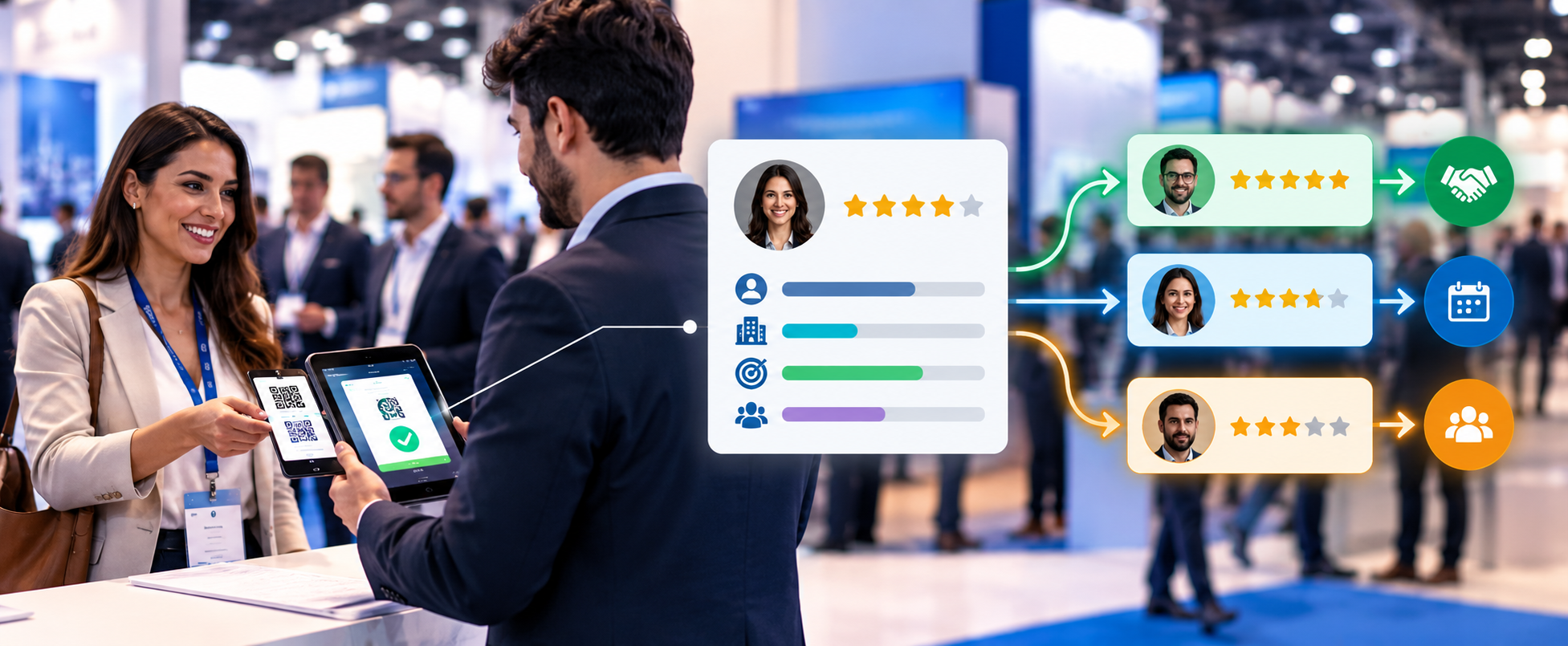
What Does Lead Scoring Mean for Event Exhibitors?
For exhibitors, it means ranking every contact captured at an event by how likely they are to become a customer. You use a points system or a model that combines who the person is with what they did during the event. The idea comes from inbound marketing, where teams score website visitors on page views, email opens, and form fills. Trade shows change the rules in three ways:- Leads arrive in a burst. Hundreds of contacts land in a few days instead of trickling in over months, so manual review is impractical.
- The strongest signals happen face to face. A ten-minute conversation about a specific integration problem tells you more than fifty email opens, but it only counts if someone records it.
- The follow-up window is short. Attendees meet dozens of vendors. By the time they are back at their desks, their memory of your booth is already fading.
Why Unscored Event Leads Lose Value So Quickly
When leads are not prioritized, most teams fall into one of two habits. Some send the same generic "Thanks for visiting our booth" email to everyone. Others hand the whole list to sales and expect them to sort it out. Both waste the event. The generic email treats your hottest prospect like a casual passerby. The raw list is worse in a quieter way. Sales reps work through it, hit a string of unqualified contacts, and conclude that "event leads are junk." The next time a list arrives, they ignore it, including the few contacts who were ready to buy. There is also a reporting problem. If you cannot show which event conversations turned into pipeline, it is hard to justify the booth cost, the travel, or sponsorship spend next year. A score gives you a way to connect the event to revenue, because you can track how each tier converts over time.The Two Dimensions of a Score: Fit and Intent
Most effective models separate who someone is from what they signalled. Mixing the two creates confusion. A senior executive who showed no interest can end up scoring higher than a mid-level manager who asked for a pricing proposal.Fit: Does This Person Match Your Ideal Customer?
Fit (sometimes called explicit or demographic scoring) is based on facts about the contact and their organization:- Job title and seniority, especially whether they influence or approve purchases
- Company size, industry, and region
- Whether the company is already a customer, an open opportunity, or a known target account
- Whether they belong to a group you cannot sell to, such as competitors, students, or other vendors
Intent: How Interested Are They Right Now?
Intent (behavioural scoring) reflects what the person did and said at the event:- Depth of the booth conversation, from a quick chat to a detailed discussion of a real problem
- Whether they requested a demo, a quote, or a follow-up meeting
- Questions about pricing, implementation timelines, or contract terms
- Attendance at your sessions, sponsored talks, or scheduled matchmaking meetings
- Repeat visits to your booth over multiple days
Negative Scoring
Subtracting points is as useful as adding them. Competitors doing research, job seekers, and people who clearly said "we just renewed with another provider for three years" should drop down the list automatically. Without negative scoring, these contacts clutter the top tier and waste sales time.How to Build a Simple Scoring Model for Your Next Event
You do not need complex software to start. A clear, agreed-upon model applied consistently beats an elaborate one that nobody trusts. Here is a practical sequence:- Define your ideal customer with sales. Agree on which titles, industries, and company sizes actually close, based on your recent won deals rather than assumptions.
- Choose a small set of qualifying questions your booth staff can ask naturally, such as current solution, timeline, and role in the decision.
- Assign points to fit and intent signals, weighting the ones that historically predict deals.
- Set tier thresholds that decide who gets a sales call, who gets a nurture sequence, and who gets nothing beyond a courtesy email.
- Agree on follow-up timing for each tier before the event starts, not after.
- Review results after 60 to 90 days and adjust the weights based on what actually converted.
| Signal | Type | Example points |
| Director-level or above in target industry |
Fit |
+20 |
| Company within target size range |
Fit |
+15 |
| Existing target account |
Fit |
+15 |
| Requested demo or proposal |
Intent |
+25 |
| Discussed timeline within 6 months |
Intent |
+20 |
| Attended your session or sponsored talk |
Intent |
+10 |
| Badge scan only, no conversation |
Intent |
+2 |
| Competitor, student, or vendor |
Negative |
−50 |
Where Lead Retrieval Fits In
Lead retrieval is the capture step: collecting attendee information at the event through badge scanning, a mobile app, or a QR code. Scoring can only be as good as the data retrieval collects. Two problems undermine scoring at this stage. The first is incomplete or inaccurate contact data: misspelled names, personal email addresses, or missing company details. The second is lost context. A rep scans a badge, has a great conversation, and never records what was said. The scan then looks identical to every other scan. The fix is to capture context at the moment of the interaction. Qualifying questions in the retrieval app, quick tags such as "demo requested" or "budget confirmed," and short notes all turn a raw scan into something scoreable. Platforms built around verified attendee identity, such as counterTEN's conference solution, aim to reduce data-quality problems at the source by connecting sponsor lead capture to confirmed attendee profiles rather than manually entered details.How AI Lead Scoring Differs from Rules-Based Scoring
The model described above is rules-based: people decide which signals matter and how many points each is worth. AI lead scoring works the other way around. A machine learning model studies your historical leads and outcomes, then identifies which combinations of attributes and behaviours actually preceded closed deals. The main advantage is that AI can find patterns humans miss. It might learn, for example, that contacts who attended a technical session and visited the booth on day two convert far better than either signal suggests alone. It has real limitations, though:- It needs history. Without enough past leads with known outcomes, predictions are unreliable. A company attending its first few events may be better served by a rules-based model.
- It can repeat past bias. If your team historically only followed up with certain segments, the model may learn that other segments "don't convert" simply because nobody tried.
- It can be hard to explain. Sales reps are more likely to trust a score when they understand why a lead ranks highly. Look for tools that show the contributing factors.
The Role of Conversation Intelligence
Conversation intelligence applies AI to what was actually said in a conversation. At events, that usually means booth notes, voice memos recorded after a chat, or transcripts of scheduled meetings. The software identifies signals such as budget mentions, named competitors, specific pain points, decision timelines, and objections. This matters because the most valuable intent data at a trade show is spoken, and spoken information is exactly what tends to get lost. A rep might tell a colleague, "That one's serious, they're replacing their current vendor next quarter," but unless that reaches the CRM, the score will never reflect it. Before recording or transcribing any attendee conversation, get clear consent and check the privacy laws that apply where the event is held and where attendees are based. Rules differ between regions, and an attendee who feels recorded without permission is unlikely to become a customer.Common Mistakes Exhibitors Make with Event Scoring
Treating every badge scan as a lead. A scan is a record of contact, not a sign of interest. Counting all scans equally inflates your numbers and buries the real prospects. Overweighting job title. Senior titles look impressive, but a curious VP with no current need is often worth less than an engaged manager who is actively evaluating options and will champion you internally. Scoring after the event instead of during it. If staff only reconstruct conversations days later from memory, most of the intent signal is gone. Build capture into the booth workflow. Skipping agreement with sales. If marketing defines a "hot" lead one way and sales defines it another, the scores will be ignored. Set the definitions together and write them down. Never revisiting the model. Your first set of weights is a hypothesis. Compare scores against actual outcomes after each event and adjust. Ignoring engagement outside the booth. Session attendance, matchmaking meetings, and sponsor activations often reveal interest that a booth conversation alone would miss.How to Tell Whether Your Scoring Is Working
The test is simple: higher tiers should convert better than lower tiers. Track these after each event:- Conversion rate to meeting, opportunity, and closed deal by tier
- Time from event to first follow-up for top-tier leads
- The share of top-tier leads that sales accepts as qualified
- Pipeline and revenue attributed to each event
Frequently Asked Questions
What is the difference between lead scoring and lead qualification?
Scoring assigns a numeric value that ranks leads against each other. Qualification is the judgment, usually made by a person, about whether a specific lead meets the criteria to become a sales opportunity. Scoring decides the order in which leads get qualified. It does not replace the qualification conversation.
How many points should a "hot" trade show lead have?
There is no universal number. The threshold depends on your point scale, deal size, and sales capacity. A practical approach is to set a threshold that produces a top tier your sales team can realistically contact within a day or two after the event, then adjust based on how those leads convert.
Can small exhibitors score leads without dedicated software?
Yes. A shared spreadsheet with agreed criteria and a few qualifying questions asked consistently at the booth works well for small teams. Software becomes more valuable as lead volume grows, when you attend multiple events, or when you want scores to update automatically in your CRM.
Is AI lead scoring more accurate than manual scoring?
It can be, once you have enough historical data with known outcomes for the model to learn from. With limited history, a well-designed rules-based model is often more reliable and easier for sales to trust. Many teams begin with rules and add AI as their data grows.
What data should be collected at the booth to support scoring?
At minimum: verified contact and company details, the attendee's role in purchasing decisions, their current solution or challenge, their timeline, and the next step they agreed to. Short notes on anything specific they said make both manual review and conversation intelligence far more useful.