What Is Tradeshow Lead Capture and Why Does It Matter at Events?
Introduction
Trade shows, conferences, and expos are still one of the most powerful ways for businesses to connect with real buyers in person. Booths are busy, conversations are happening constantly, and sales teams often leave events feeling like they had a successful show.
But success at an event is not measured by how many people stopped by your booth. It is measured by how many of those conversations turn into real business opportunities afterward.
This is exactly where tradeshow lead capture becomes critical.
Most companies don’t lose leads at the event—they lose them after the event. Conversations are forgotten, notes are incomplete, business cards go missing, and follow-up becomes slow or generic. The result is simple: valuable opportunities quietly disappear.
Modern event marketing is no longer about collecting contacts. It is about capturing intent, preserving context, and acting quickly enough to convert interest into pipeline. That is the real purpose of tradeshow lead capture.
What Is Tradeshow Lead Capture?
Tradeshow lead capture is the process of collecting attendee information during an event and turning it into actionable sales data. This includes contact details, but more importantly, it includes the context of the conversation that took place at the booth or meeting.
In earlier times, this process was manual. Business cards were collected, notes were written on paper, and everything was later entered into spreadsheets. Today, the process is digital, faster, and far more connected.
Modern lead capture systems allow exhibitors to scan badges, capture QR codes, log conversations, and sync everything directly into a CRM in real time. But the real value is not in the tool itself—it is in how quickly and accurately that information moves from the event floor into a structured follow-up process.
A lead without context is just a name. A lead with context becomes a potential deal.
That is the core difference between basic data collection and effective tradeshow lead capture.
Why Tradeshow Lead Capture Matters More Than Ever
Events are expensive. Between booth space, travel, staffing, branding, and logistics, companies often invest thousands of dollars in a single trade show. Naturally, they expect measurable returns.
However, research and industry reports consistently show a major gap between lead collection and lead conversion. A large portion of event leads never receive proper follow-up, not because they are unqualified, but because the system behind them is weak.
One widely referenced industry insight suggests that a significant percentage of trade show leads never get any follow-up at all. This is not a sales problem—it is a process problem.
The issue becomes even more critical when you consider timing. Event leads are highly time-sensitive. A conversation that feels warm at the booth can go cold within days if there is no structured follow-up. Decision-makers meet multiple vendors at events, and whoever responds first with relevance usually gains the advantage.
This is why tradeshow lead capture directly impacts ROI. It determines whether your event investment becomes pipeline or just activity.
The Real Problem: Lost Context After the Event
One of the biggest challenges in event marketing is not losing contact information—it is losing meaning.
A typical scenario looks like this:
A visitor comes to your booth, asks about your product, shares a business challenge, and shows genuine interest. The representative scans the badge and moves on to the next conversation.
Later, that lead appears in the CRM as a basic entry. The sales team sees a name, company, and email—but none of the conversation context.
At that point, follow-up becomes generic. Instead of continuing a meaningful discussion, the sales team has to restart the conversation from scratch.
This is known as context loss, and it is one of the biggest reasons event ROI drops after the show ends.
Strong tradeshow lead capture systems solve this by ensuring that context is recorded at the moment of interaction, not after it is forgotten.
How Modern Tradeshow Lead Capture Works
Today’s event technology has significantly improved how lead capture operates. Instead of relying on memory or manual entry, teams use structured digital workflows.
A modern lead capture process typically works like this:
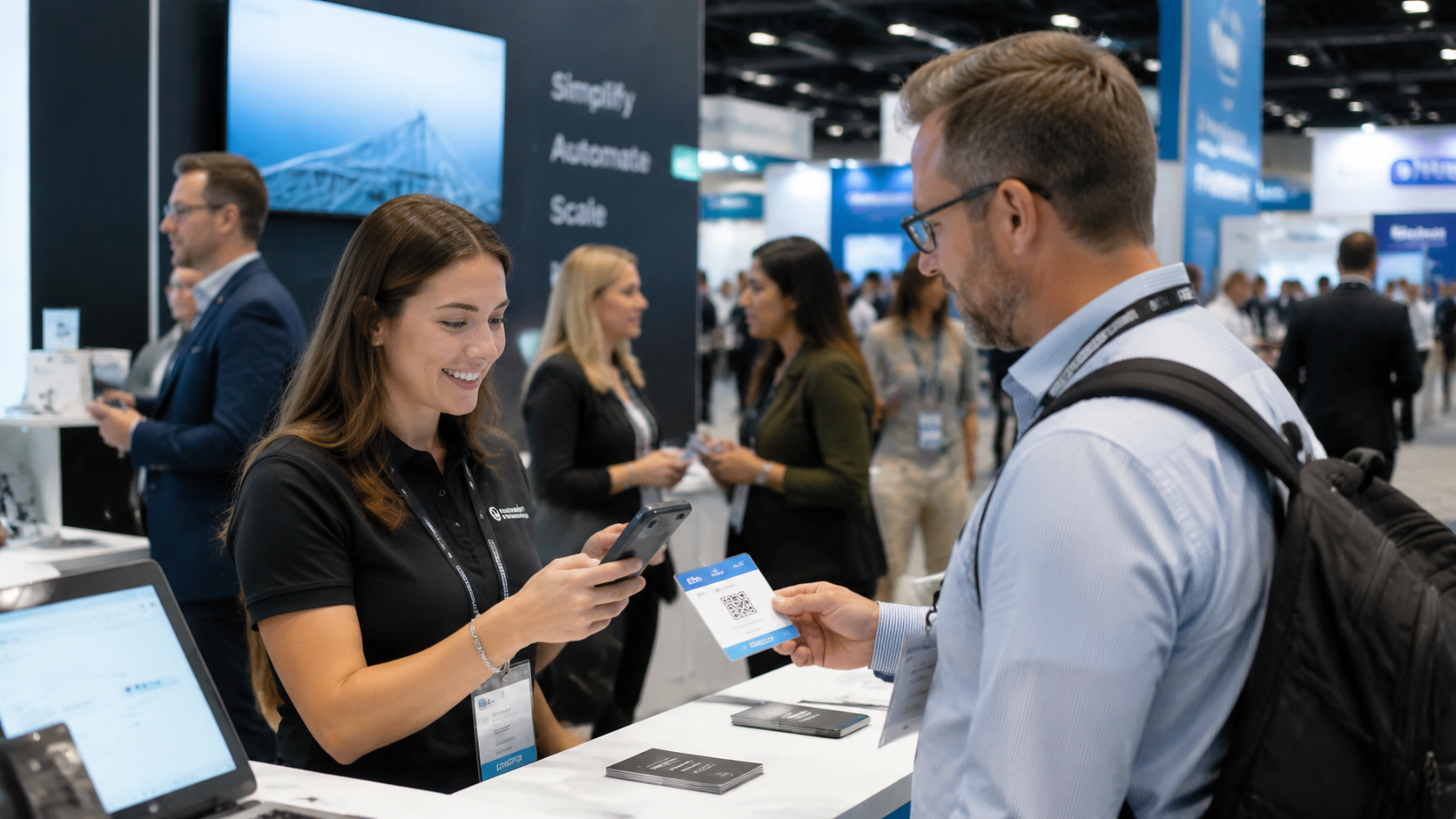
A booth representative scans an attendee’s badge or QR code using a mobile device or a trade show lead retrieval app. Immediately after the scan, they add notes about the conversation, including the attendee’s interest, urgency, and next steps. The system then stores this data and syncs it directly into a CRM or event platform.
In advanced setups, the data is enriched automatically with company details, job roles, and industry information. This allows sales teams to prioritize leads more effectively without manual research.
The most important improvement is speed. Instead of waiting days for exported files, leads appear in the CRM in real time. This means follow-up can begin while the event is still ongoing.
That speed advantage is often the difference between winning and losing a deal.
Lead Capture vs Lead Retrieval: A Practical Difference
Although often used interchangeably, lead capture and lead retrieval are not the same thing.
Lead retrieval usually refers to the official system provided by event organizers. It allows exhibitors to scan attendee badges and access registration data. It is structured, standardized, and limited to what the event platform provides.
Lead capture, on the other hand, is a broader concept. It includes any method used to collect, qualify, and act on leads during an event. This includes mobile apps, QR systems, digital business cards, and CRM-integrated tools.
In simple terms, lead retrieval is about accessing data. Lead capture is about using data effectively.
Most high-performing teams combine both approaches to ensure no opportunity is missed.
What Effective Lead Capture for Events Looks Like
A strong lead capture for events strategy is not defined by the tool—it is defined by the workflow.
The most effective systems ensure five things happen consistently.
First, leads are captured quickly without slowing down conversations. Second, context is recorded immediately after interaction. Third, leads are categorized based on intent or priority. Fourth, data is synced directly into the CRM without delay. Finally, follow-up is triggered within hours, not days.
When this flow works properly, events stop being isolated marketing activities and start becoming structured revenue channels.
Common Mistakes in Tradeshow Lead Capture
Many companies lose event ROI due to avoidable mistakes. One of the most common is focusing only on lead quantity instead of lead quality. Collecting hundreds of names without context does not create pipeline.
Another common issue is delayed follow-up. When leads sit in spreadsheets after the event, their value drops significantly.
Teams also often fail to train booth staff properly. Without clear guidelines, different representatives capture inconsistent or incomplete information.
Finally, many companies rely too heavily on manual processes, which increase the risk of errors and lost data.
Each of these mistakes reduces the effectiveness of even the best event strategy.
Best Practices for Higher Event ROI
Successful exhibitors treat tradeshow lead capture as a structured system, not an afterthought.
They define what a qualified lead looks like before the event begins. They train booth staff to capture not just contact details but meaningful conversation insights. They use tools that sync data instantly to CRM systems. And they ensure that follow-up messages are personalized based on real interactions.
Most importantly, they prioritize speed. The faster a lead is followed up, the higher the chance of conversion.
When these practices are followed consistently, event ROI improves dramatically.
How AI Is Changing Lead Capture at Events
The next evolution of tradeshow lead capture is intelligence.
AI and automation are now being used to enrich lead data, summarize conversations, and suggest next steps. Instead of relying only on manual notes, systems can now help identify high-intent prospects automatically.
This reduces human error and ensures that sales teams focus on the most valuable opportunities first.
It also improves personalization. Follow-ups can be tailored based on conversation topics, industry, or urgency, making communication more relevant and effective.
As events become more data-driven, AI-powered capture will become a standard expectation rather than an optional upgrade.
FAQs
What is tradeshow lead capture?
Tradeshow lead capture is the process of collecting attendee details and conversation context during events and turning them into sales-ready opportunities. It includes scanning badges, recording notes, and syncing data into CRM systems so sales teams can follow up quickly with relevant, personalized communication that improves conversion rates.
Why is lead capture important at trade shows?
Lead capture is important because trade shows generate high-value prospects, but without proper tracking and follow-up, many leads are lost. It ensures conversations are recorded, organized, and acted on quickly. This helps businesses convert interest into pipeline while improving event ROI and reducing wasted marketing spend.
What is the difference between lead capture and lead retrieval?
Lead retrieval is the process of scanning attendee badges using event-provided tools to access registration data. Lead capture is broader, including retrieval plus qualification, notes, CRM sync, and follow-up workflows. In short, retrieval collects data, while capture turns that data into actionable sales opportunities.
How quickly should event leads be followed up?
Event leads should ideally be followed up within 24 to 48 hours. Faster response increases conversion chances because interest is still fresh. Delays often result in lost opportunities or competitors responding first. Real-time CRM sync allows teams to start follow-ups even during the event.
What tools are used for lead capture for events?
Common tools include trade show lead retrieval apps, badge scanners, QR code systems, NFC digital cards, and CRM-integrated platforms. These tools help capture attendee data quickly, add qualification details, and sync information in real time, ensuring no lead is lost during or after the event.
What is the biggest mistake in event lead management?
The biggest mistake is collecting leads without adding context or following up quickly. Many teams gather contacts but fail to qualify or prioritize them. Without proper notes and timely action, even strong leads lose value, reducing overall event ROI and wasting marketing investment.
Can AI improve tradeshow lead capture?
Yes, AI improves lead capture by enriching data, summarizing conversations, and identifying high-intent leads automatically. It reduces manual work, speeds up CRM updates, and helps personalize follow-ups. This leads to better prioritization, stronger engagement, and improved conversion rates from event-generated leads.