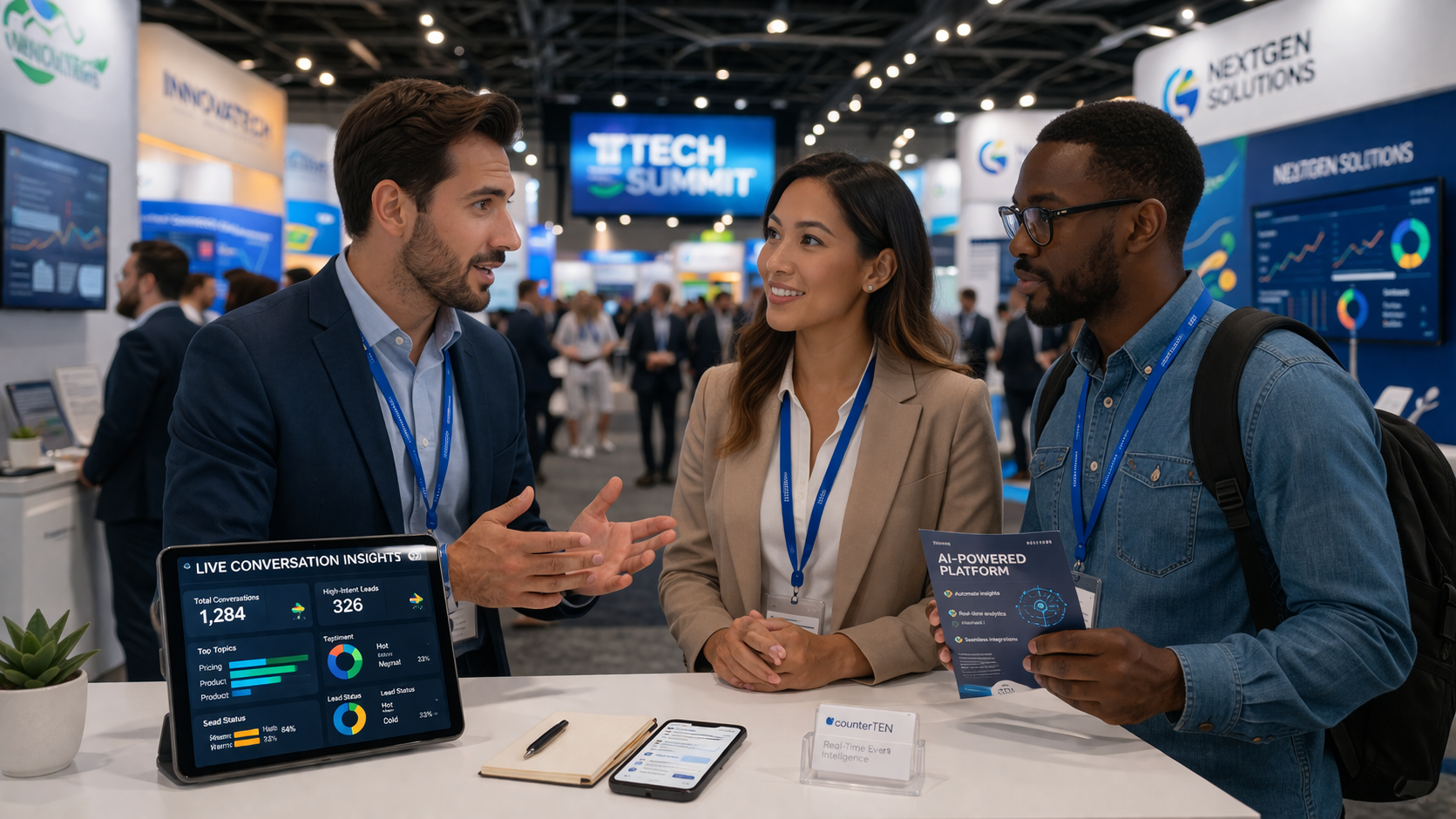
There's a moment every event professional recognizes. It happens around hour six of a conference, somewhere between the afternoon keynote and the cocktail hour. Your team has had dozens of conversations. The energy is high. The leads feel strong. And then somebody asks: "So what are we actually walking away with?"
That question used to have a frustrating answer. Scattered business cards. Half-filled lead forms. Notes that made sense at 2 PM but look cryptic by morning. A handful of memorable conversations and the nagging feeling that the most interesting ones weren't written down at all.
This is precisely the problem that modern
conference conversation capture was built to eliminate and why organizations that implement it intelligently gain a genuine competitive edge that their competitors simply cannot match with traditional event tactics.
The Gap Between Conversations and Decisions
Here's what nobody in the events industry talks about enough: the real cost of losing conference intelligence isn't just missed leads. Its bad decisions are made with incomplete information.
When a product team walks away from three days of conference activity without a structured picture of what attendees asked, questioned and reacted they go back to their offices and make assumptions. They assumed the messaging worked. They assume the pricing objections were outliers. They assume the two booth visitors who asked about a specific feature were just curious, not signaling unmet demand.
Those assumptions compound. They shape product roadmaps, marketing campaigns and sales scripts built on data that was never properly collected.
Real-time conference conversation captures breaking that pattern entirely. Not by adding complexity to what your team already does but by structuring the intelligence that's already flowing through every interaction on the floor. The conversations are already happening. The question is whether anyone is capturing them in a way that's usable.
Our platform does exactly this capturing interaction data now it occurs, organized in a way that feeds directly into decision-making before the event even ends.
Why Speed Is the Entire Point
The instinct for most organizations is to think of event data as a post-event activity. You collect during the conference, then you analyze and act after it wraps up. This approach is outdated and not because technology has changed because of the competitive landscape has.
Decision cycles in modern business are shorter. Attendee expectations are higher. Sponsor accountability standards have tightened. And the window for acting on conference intelligence has compressed dramatically.
A prospect who had a strong conversation with your booth team on Tuesday morning is already getting follow-up calls from three competitors by Tuesday evening. If your team is still reconciling notes on Wednesday, you are not slow you've already lost.
Real-time conference conversation captures the entire timeline. With the counterTEN platform, your event managers can see live engagement trends as they develop. They can identify which topics are generating the most interest mid-morning and brief the booth staff before lunch. They can spot which
conference booth conversations trend toward high intent and route them to senior sales staff before that prospect leaves the building.
This is decision-making that happens inside the event, not after it and the difference in outcomes is significant.
What Gets Lost Without a Structured System
Consider a realistic scenario. Your team sends eight people to a three-day conference in San Diego. Across the event, they collectively have somewhere between 200 and 400 meaningful interactions. Each of those interactions carries context: what the attendee asked, what they pushed back on, what they got excited about, what they were skeptical of and whether they're likely to take the next step.
Without a structured event lead capture system, here's what gets preserved: the conversations your team members personally remember, filtered through individual interpretations, logged manually at some point during or after the event, with inconsistent tagging and no standardized priority scoring. You end up with 400 data points compressed into maybe 40 coherent records and even those carry the subjective bias of whoever entered them.
Multiply that across a year of conferences and you have a fundamentally broken intelligence loop. Your team is going to event after event, spending real budget, generating real conversations and walking away with a fraction of what those interactions were worth.
The counterTEN approach to conference conversation capture standardizes the collection process at the point of interaction. Staff capture structured data in real time interest level, topic tags, follow-up intent, conversation context through an interface that requires no app download and integrates naturally into the flow of the interaction. The result is a data set that's consistent, searchable and ready for analysis within hours rather than weeks.
The Sponsor Dimension Nobody Optimizes
If you run events with sponsor partners, real-time conversation captures the entire nature of that relationship in ways most organizers haven't fully appreciated yet.
Sponsors today are sophisticated buyers. They have internal metrics, attribution models, and ROI benchmarks they apply to every event investment. When they ask for performance data and you hand them an attendance headcount and a badge scan report, you're not answering the question they're asking. They want to know what conversations happened at their activation, what the quality of those interactions looked like, and whether the investment is defensible against other marketing channels.
The conference sponsor platform capabilities built into counterTEN address this directly. Each sponsor booth or activation point becomes its own capture node within the system. Engagement data rolls up into sponsor-specific reports that show interaction volume, topic frequency, engagement quality scores, and follow-up pipeline value. Organizers can hand sponsors a precise, data-backed account of what their investment generated, not a vague post-event summary.
This shifts sponsor relationships from transactional to strategic. When sponsors see that your event delivers documented, measurable ROI at a granular level, renewal conversations become substantially easier and sponsorship rates reflect that accountability premium.
Data Quality Is a Team Sport
One thing counterTEN has learned through working with events across San Diego and beyond: the quality of captured data depends heavily on how consistently it gets collected across the team. This sounds obvious, but most organizations underinvest in the structural side of it.
When eight people are working a conference floor with no standardized capture framework, you get eight different interpretations of what a "strong lead" looks like. One team member logs every conversation. Another only logs the ones that felt promising. A third skips logging entirely when the booth gets busy. By the end of day one, your data set is already unreliable.
Structured conference conversation capture solves this at the system level. The counterTEN platform deploys predefined capture categories and interaction tags that all team members work from consistently. Because the interface is frictionless and works directly on any smartphone without additional setup, adoption is immediate rather than aspirational. Every conversation gets captured the same way, regardless of who had it.
As a result, the aggregate data that flows to management and sponsors reflects actual event activity — not a curated sample filtered through individual discretion.
Building a Long-Term Intelligence Asset
Here's the angle that doesn't get discussed enough in conversations about event conversation intelligence: every conference you instrument becomes a building block in a longer-term data asset.
When you run structured capture at event after event, you start to see patterns that are invisible in any single event's data set. You see which topics consistently generate high-intent conversations across different audience types. You see which messages produce strong initial engagement but weak follow-through. You see which competitor names keep surfacing in prospect questions. You see which geographic markets are generating the most qualified pipeline from conference activity.
This longitudinal view is genuinely valuable for strategy product strategy, marketing strategy, sales enablement, and event portfolio decisions. The organizations that implement consistent
conference conversation capture now are building an intelligence advantage that compounds over time. Those who continue with manual processes are generating noise, not data.
For companies in San Diego's technology and innovation sectors especially, where event activity is dense and conference ROI scrutiny is high, this distinction is increasingly significant. counterTEN is built specifically to serve organizations that want to operate this way treating events as intelligence infrastructure, not just pipeline opportunities.
The counterTEN Difference
At
counterTEN, our platform was designed around one core principle: the best event intelligence is the kind that captures without disrupting.
Every feature in our system the frictionless smartphone integration, real-time dashboards, the structured tagging framework, the sponsor reporting layer is built to generate high-quality data without slowing your team down or adding friction to attendee interactions. Because when capturing data becomes a burden, it stops happening consistently. And inconsistent data is almost worse than no data, because it creates the illusion of insight without reality.
If your organization hosts, sponsors or exhibits at conferences and you're serious about making data-driven decisions at the speed events move, we'd like to show you how this works in practice. Visit
counterTEN to connect with our team.
Frequently Asked Questions
Q1: How does conference conversation capture work when both staff are busy and can't stop to log every interaction?
This is one of the most common concerns, and it's a legitimate one. The counterTEN platform is designed specifically for high-traffic environments. The capture interface is streamlined to require only a few seconds per interaction, uses pre-set tags and intent categories instead of open-text entry, and works from any smartphone without setup. Staff can log into the key parameters of a conversation in the time it takes to hand someone a brochure without breaking the flow of the interaction itself.
Q2: What's the difference between real-time conversation capture and standard lead retrieval systems offered by event venues?
Standard lead retrieval systems typically capture contact information through badge scans, with minimal additional context. Real-time conference conversation capture goes deeper recording structured interaction context, topic tags, engagement quality indicators, follow-up intent, and staff note now of the conversation. The result is a data set that's analytically useful rather than just a list of contacts with no context attached to them.
Q3: Can the counterTEN platform support multi-sponsor events where different sponsors need separate data access?
Yes. The platform supports role-based data segmentation, meaning each sponsor organization accesses only the interaction data tied to their specific activation points. Event organizers control what data is shared at the sponsor level, and the reporting layer generates sponsor-specific dashboards and performance reports independently. This structure protects data privacy while delivering accountability each sponsor expects.
Q4: How does structured conversation capture improve post-event follow-up quality specifically?
Because every interaction is logged with topic tags and intent signals in real time, the follow-up workflow starts with context rather than guesswork. Sales teams receive prioritized lead lists that reflect actual conversation depth distinguishing high-intent prospects from general inquiries based on what was discussed, not just how long someone stood at the booth. Personalized follow-ups become genuinely personalized, not just name-merged templates.
Q5: Does real-time conversation capture a practical option for mid-sized organizations that don't have large event teams?
Absolutely, and in some ways mid-sized organizations benefit most from it. Larger teams can absorb the inefficiency of manual processes because they have volume. Smaller, leaner teams cannot afford to lose intelligence to bad processes every conversation carries more relative weight. The counterTEN platform scales based on the size of your event operation, and the frictionless interface means a team of three can capture as consistently and accurately as a team of thirty.