Every major conference produces something most organizers overlook, a massive, unstructured river of spoken knowledge. Keynote insights, breakout debates, audience questions, spontaneous hallway conversations all of them disappear the moment the microphones go quiet. A
conference AI transcript changes that entirely. It turns every spoken word into structured, searchable, and actionable data. And if you’ve been running events in San Diego without one, you’re likely leaving your most valuable post-event asset on the table.
This isn’t just about capturing what was said. It’s about understanding why it was said, and what your audience genuinely cares about.
What a Conference AI Transcript Actually Does
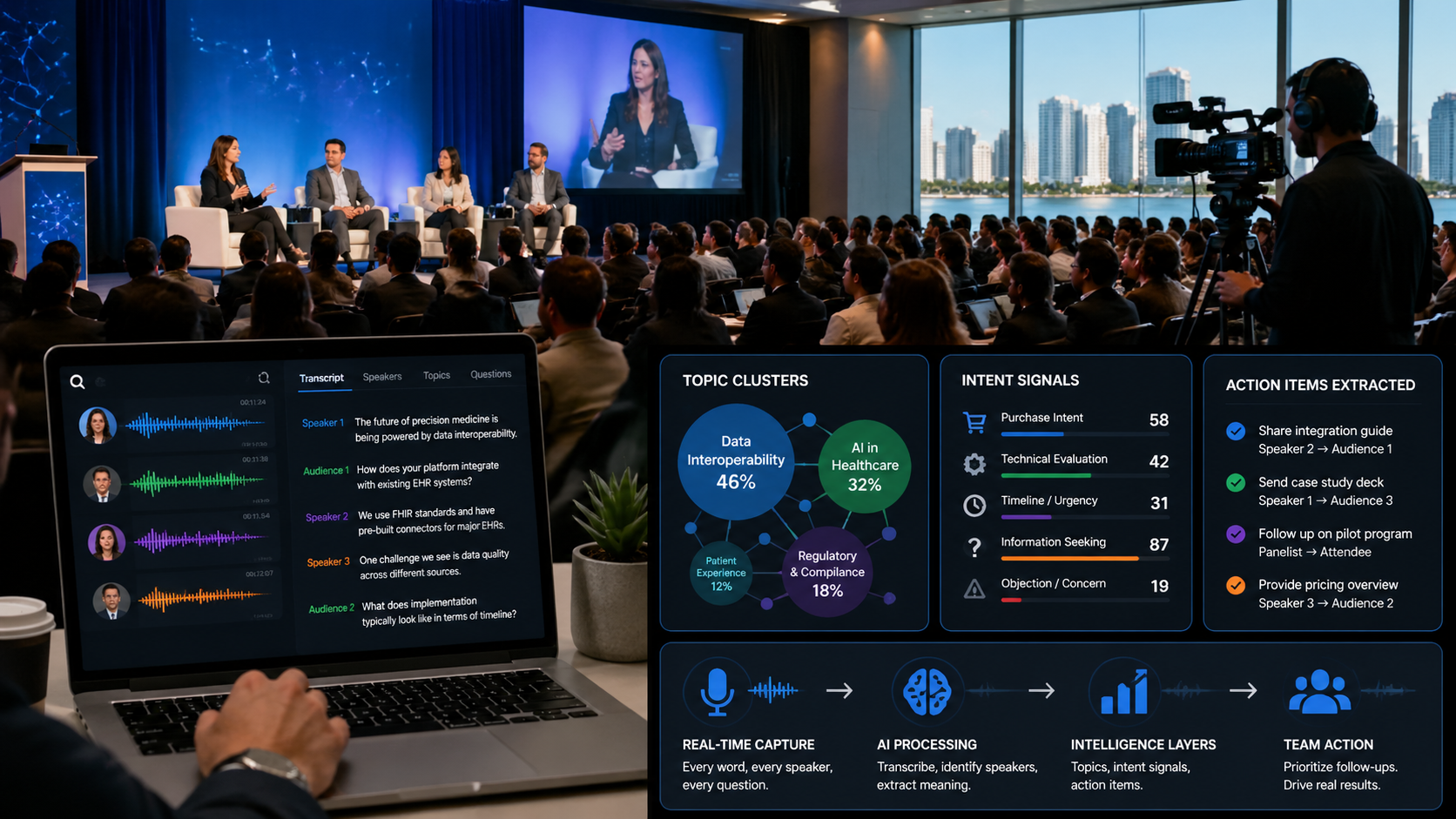
Most people assume AI transcription is glorified speech-to-text. It isn’t. A modern conference AI transcript system does far more than convert audio into a wall of words. It identifies individual speakers, tracks topic shifts in real time, flags questions from the audience, and even detects emotional cues like enthusiasm, skepticism, or urgency in tone.
At counterTEN, we’ve built our conference transcription service around a simple truth: the conversations happening inside your event tell you more about your audience than any post-event survey ever will. When someone asks a pointed question from the floor during a panel, that moment carries intent. When a speaker circles back to a topic three times, that repetition signals importance. A well-structured conference AI transcript captures all these signals accurately and organizes them in a way your team can use.
What makes this particularly valuable for conference organizers and businesses in San Diego is the scale of information flowing through any given event. A single-day conference can generate six to eight hours of spoken content across multiple sessions. Without AI-powered transcription, most of that content is simply lost.
How Real-Time Capture Works
The technical backbone of real-time conference transcription involves acoustic modeling, natural language processing and speaker diarization which is the process of identifying and labelling who is speaking at any given moment. These systems work simultaneously, not sequentially.
As a speaker delivers a keynote, the AI model is processing audio in milliseconds, assigning words to the correct speaker, and tagging semantic categories like announcements, questions, data points, and calls to action. By the time the session ends, you already have a complete, time-stamped transcript organized by speaker and topic.
counterTEN’s approach takes this a step further by layering audience intent analysis on top of the raw transcript. We don’t just record questions we categorize them. A question about pricing signals purchase intent. A question about integration signals technical evaluation. A question about timelines signals urgency. When these signals get mapped across an entire audience, the patterns that emerge are genuinely eye-opening for any sales or marketing team.
Why Audience Intent Is the Real Gold
Event organizers often measure success by attendance numbers, session ratings, or lead counts. Those metrics matter, but they don’t tell you what your audience is thinking. Intent data does.
When you have a complete conference AI transcript with intent analysis, you can answer questions like:
- Which topics generated the most audience engagement?
- What objections came up repeatedly across multiple sessions?
- Which speakers drove the deepest conversations?
- What are attendees planning to do after the event?
That last question connects directly to conference AI next steps the ability to identify what actions attendees are likely to take based on what they asked, how they responded, and what language they used. This is where transcription stops being a documentation tool and starts becoming a strategic business asset.
For companies in San Diego using counterTEN’s conference transcription services, this intent layer has helped sales teams prioritize follow-ups, allowed marketing teams to build smarter nurture campaigns, and given leadership clearer insight into what messaging resonates with their audience.
The Gap Between Notes and Intelligence
Here’s something every conference organizer has experienced: you take notes, your team takes notes, maybe someone records a session or two. Then the event ends, and three weeks later nobody can find the important moment from the panel discussion or remember exactly what that speaker said about the market shift everyone found so compelling.
Manual notetaking is inconsistent by nature. Different people capture different things. Attention drifts. A critical insight slips by unrecorded. AI-powered conference transcription removes that inconsistency entirely. Every word gets captured. Every exchange gets documented. And unlike a scattered folder of notes, a structured transcript is searchable, shareable, and referenceable months after the event ends.
This matters especially for industries where compliance, knowledge management or thought leadership documentation is important healthcare, finance, technology, and legal sectors all operate in San Diego in large numbers. For those teams, having an accurate, verified record of what was said at an industry event isn’t optional. It’s essential.
counterTEN’s real-time event transcription platform is purpose-built for these environments. Beyond just accuracy, our system produces transcripts that are formatted for readability, tagged for search, and compatible with CRM and documentation platforms your team already uses.
From Transcripts to Action: The Conference AI Next Steps Framework
A transcript sitting in a folder accomplishes nothing. The value of a conference AI transcript lives in what you do with it after the event. This is where counterTEN’s post-event workflow tools come into play.
Once a transcript is complete, our platform extracts three key layers of intelligence:
Topic Clustering — All conversations across sessions get grouped by subject matter. If five different speakers touched on the same theme, you’ll see that pattern clearly, along with the different angles each person took.
Intent Signals — Questions, statements of interest, and expressions of concern from the audience get categorized by intent type. Sales teams use this to prioritize outreach. Product teams use it to inform roadmaps.
Action Item Extraction — Any commitment, next step, or follow-up mentioned during sessions gets pulled out automatically. Whether a speaker promised to share resources or a panelist agreed to connect with an attendee, those moments don’t get lost.
Together, these layers give your team a clear, structured picture of what happened at your event and what needs to happen next. That’s the full conference AI next steps workflow, and it transforms a passive documentation process into an active intelligence system.
Why San Diego Organizations Choose counterTEN
San Diego hosts a remarkable concentration of biotech firms, defense contractors, tech startups, and professional service organizations all running events that generate significant institutional knowledge. The challenge isn’t a lack of good conversations. The challenge is capturing and organizing them on a scale.
counterTEN brings together verified identity tracking, engagement analytics, and AI-powered transcription into a single platform designed for professional conference environments. Our clients don’t just get a transcript, they get a complete picture of who attended, what they cared about, and where the conversation is heading.
If you’re planning a conference in San Diego or you’re responsible for extracting value from events your organization already runs, we’d genuinely encourage you to explore what a professional conference AI transcript service can do for your team.
Visit
counterTEN to learn more about how counterTEN approaches conference intelligence.
Frequently Asked Questions
Q1. How accurate is a conference AI transcript when multiple speakers are talking at the same time?
Modern speaker diarization technology handles overlapping speech reasonably well, though accuracy does vary depending on audio quality and the number of simultaneous speakers. The best results come from conferences with dedicated microphones per speaker or lapel mics. In environments with crowd-level microphones, AI systems typically achieve strong accuracy for the primary speaker and partial accuracy for secondary voices. counterTEN recommends an audio setup review before any large event to ensure the transcript quality meets your team’s standards.
Q2. Can a conference AI transcript capture questions from a live audience, not just panelists and keynote speakers?
Yes, provided the venue has audience microphones or roving mics during Q&A sessions. The AI system identifies all active audio sources, assigns speaker labels, and transcribes audience questions with the same accuracy as panel responses. Intent analysis applied to audience questions is particularly valuable because it surfaces what attendees are genuinely curious or concerned about information that doesn’t always appear in post-event surveys.
Q3. How does intent analysis distinguish between a casual comment and a genuine buying signal?
Intent classification models are trained on large datasets of professional conversation, sales interactions, and event dialogue. They look at multiple factors simultaneously: the specific language used, the context of the conversation, the position of the statement within the session, and the speaker’s role (attendee vs. panelist vs. organizer). A question like “Does your platform integrate with Salesforce?” carries a different intent signature than “That’s an interesting concept.” The model assigns confidence scores to each classification so your team can prioritize accordingly.
Q4. What happens to the transcript data after the event, how it is stored and who has access?
Data handling practices vary by provider, and this is an important question to ask before choosing any transcription service. At counterTEN, transcript data is stored in encrypted environments, access is controlled at the organizational level, and clients retain full ownership of their content. We do not use client event data to train AI models without explicit permission, and our data retention policies are clearly outlined in our service agreements.
Q5. How do conference AI next steps get delivered to the team after an event is it a separate report or integrated into existing tools?
counterTEN delivers post-event intelligence in multiple formats depending on your team’s workflow. Standard output includes a structured transcript document, a topic cluster summary, and an intent signal report. For teams that want deeper integration, our platform connects with CRM tools, Slack, and project management systems so that action items and follow-ups flow directly into your existing processes. We also offer a custom briefing format for executive stakeholders who need a concise summary without the full transcript detail.